Search
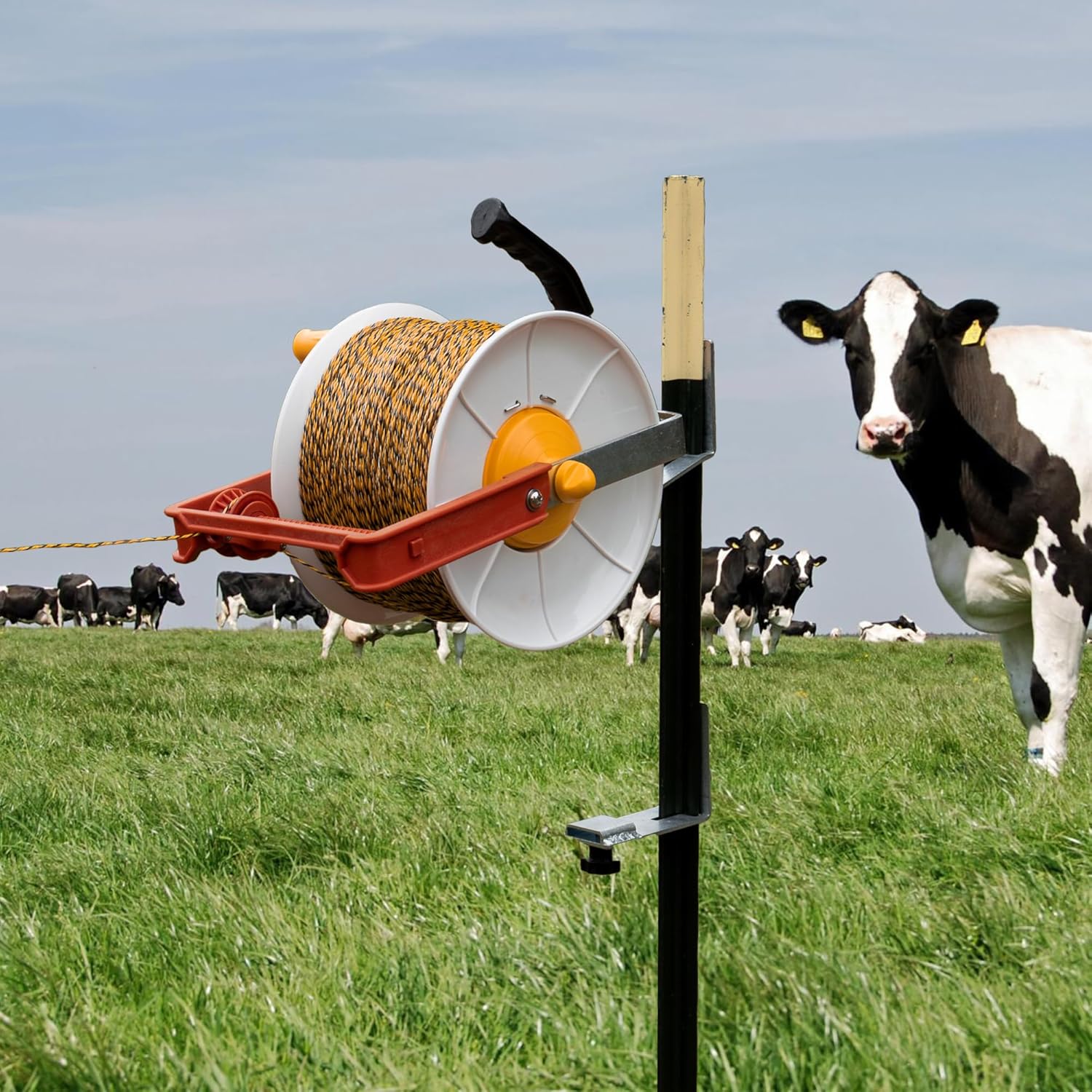
Electric fence reels are an important component of temporary and portable electric fencing systems. They allow farmers to install, collect, transport, and store electric fence conductors more efficiently, especially in rotational grazing and livestock management applications.
Among the different types of electric fence reels available on the market, 1:1 standard reels and 3:1 geared reels are two common options. Although they serve the same basic purpose, their winding mechanisms, operating efficiency, and applications are different.
Understanding these differences can help farmers, distributors, and electric fencing retailers select the right products for their needs.
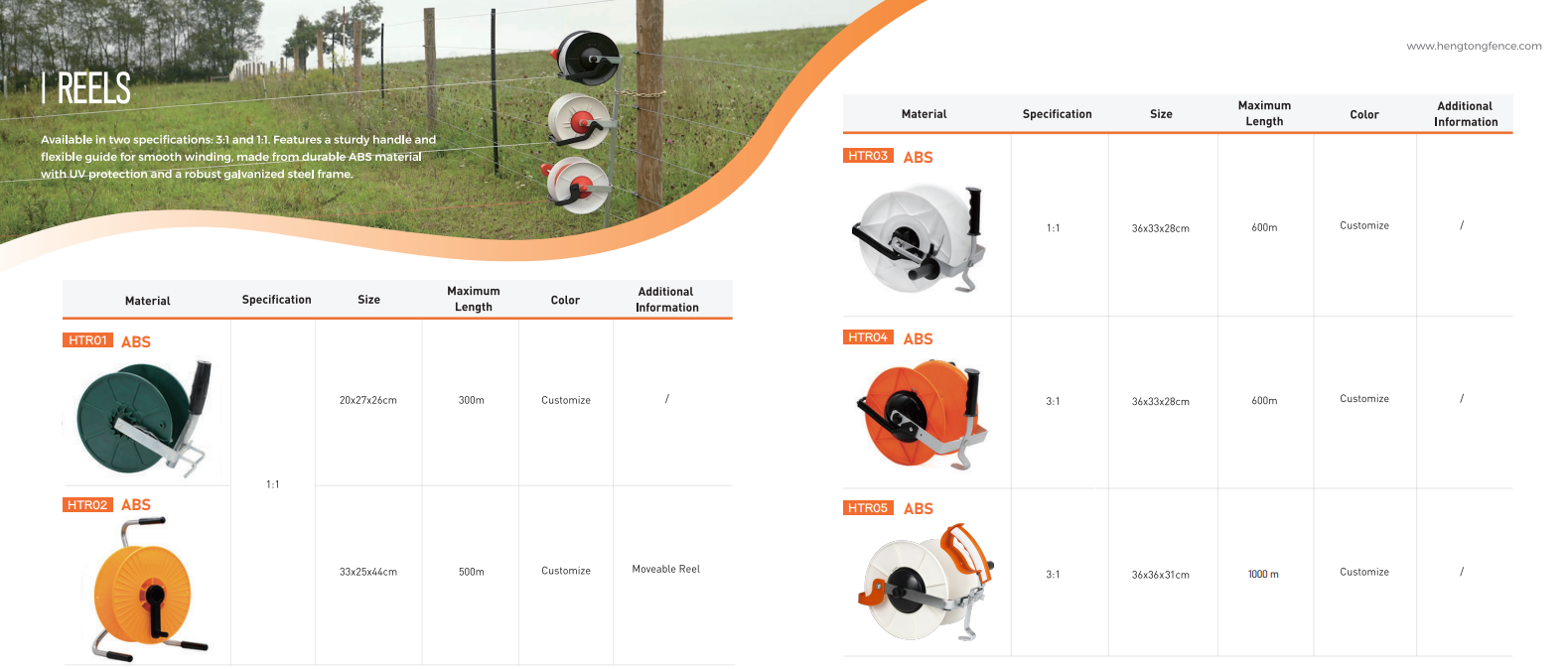
A 1:1 electric fence reel uses a direct-drive winding mechanism. Each complete rotation of the handle produces one complete rotation of the spool.
Its relatively simple mechanical structure makes it a practical and economical option for everyday electric fencing applications.
Key advantages:
Simple mechanical structure
Easy operation and maintenance
Generally lower purchasing cost
Suitable for shorter fencing distances
Practical for occasional fence relocation
For farmers who do not frequently move their electric fences, a 1:1 reel can provide a cost-effective solution.
A 3:1 electric fence reel incorporates a gear transmission mechanism. Each complete rotation of the handle produces three rotations of the spool.
Compared with a standard 1:1 reel, the geared design allows users to collect electric fence conductors more quickly at the same handle rotation speed.
For example, when the handle is rotated 100 times:
A 1:1 reel completes 100 spool rotations.
A 3:1 reel completes 300 spool rotations.
This makes geared reels particularly useful when collecting long lengths of polywire or frequently relocating temporary electric fences.
Key advantages:
Faster winding speed
Fewer handle rotations
Improved fence relocation efficiency
Suitable for frequent rotational grazing
Practical for larger pasture management applications
Actual winding efficiency depends on spool diameter, conductor tension, and operating conditions.
| Feature | 1:1 Standard Reel | 3:1 Geared Reel |
|---|---|---|
| Gear Ratio | 1:1 | 3:1 |
| Spool Rotations per Handle Turn | 1 | 3 |
| Winding Speed | Standard | Faster |
| Mechanical Structure | Direct Drive | Gear Transmission |
| Handle Torque at Equal Line Tension | Generally Lower | Generally Higher |
| Maintenance | Relatively Simple | More Mechanical Components |
| Purchasing Cost | Generally Lower | Generally Higher |
| Fence Relocation | Occasional | Frequent |
| Market Positioning | Economical | Professional |
Both types of reels have their own advantages. The best choice depends on the fencing application, frequency of use, conductor length, and purchasing budget
Gear ratio is not the only factor to consider when selecting an electric fence reel. Spool capacity and conductor compatibility are equally important.
Different electric fence conductors require different amounts of storage space.
Polywire
Polywire is relatively thin and lightweight, making it particularly suitable for portable electric fence reels and temporary fencing systems.
Polyrope
Polyrope has a larger diameter and requires more spool space. Reels with sufficient capacity should be selected according to rope diameter and length.
Polytape
Polytape requires suitable spool width and capacity to accommodate its flat woven structure and prevent excessive folding or twisting during winding.
When selecting a reel, buyers should consider:
Conductor diameter or width
Total conductor length
Spool capacity
Gear ratio
Handle design
Locking mechanism
Frame and spool materials
A suitable combination of reel and conductor can improve installation, collection, and storage efficiency.
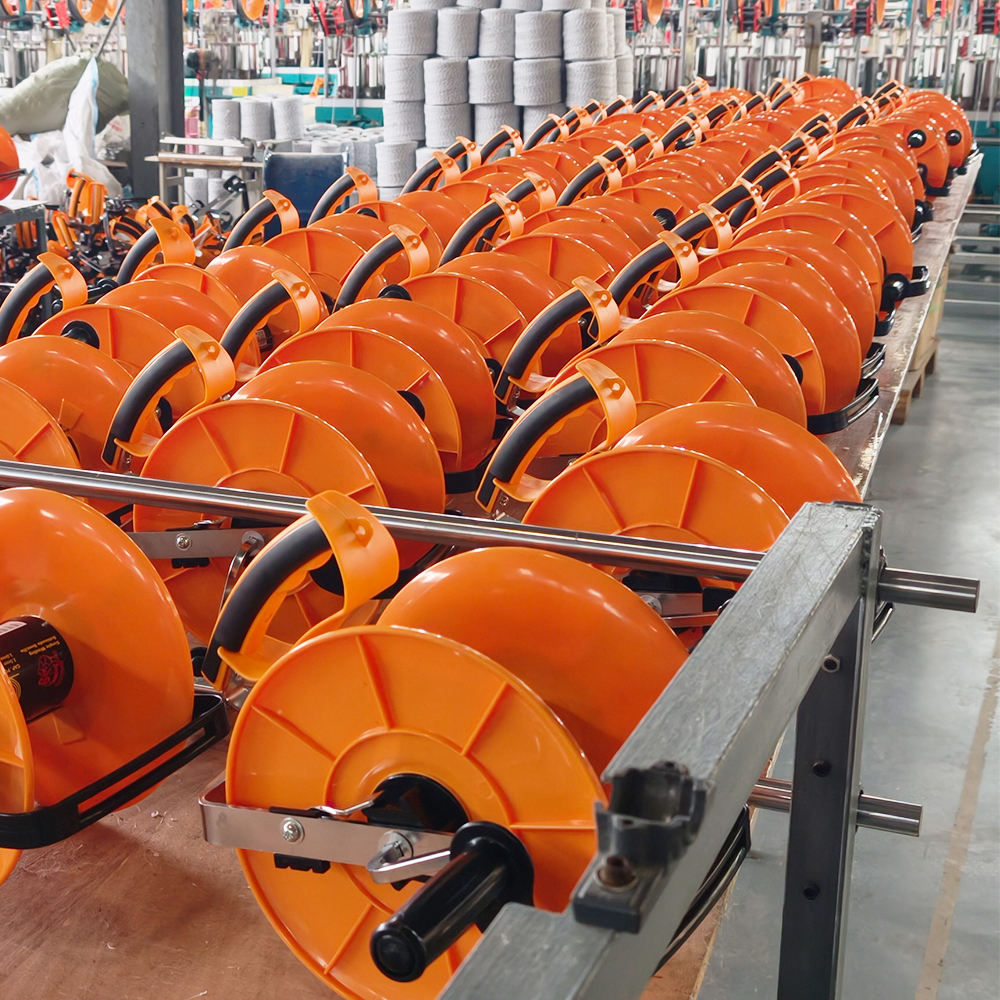
For electric fencing distributors and wholesalers, offering both types of reels can help meet different customer requirements.
The 1:1 standard reel can be positioned as an economical option for general agricultural fencing, while the 3:1 geared reel can be positioned as a professional solution for customers who frequently relocate their fences.
Distributors can also offer different product combinations, such as:
Empty electric fence reels
Reels pre-loaded with polywire
Reels with compatible polyrope or polytape
Reel and gate handle combinations
Complete temporary electric fencing kits
These combinations allow distributors to expand their product range and provide more convenient purchasing options for their customers.
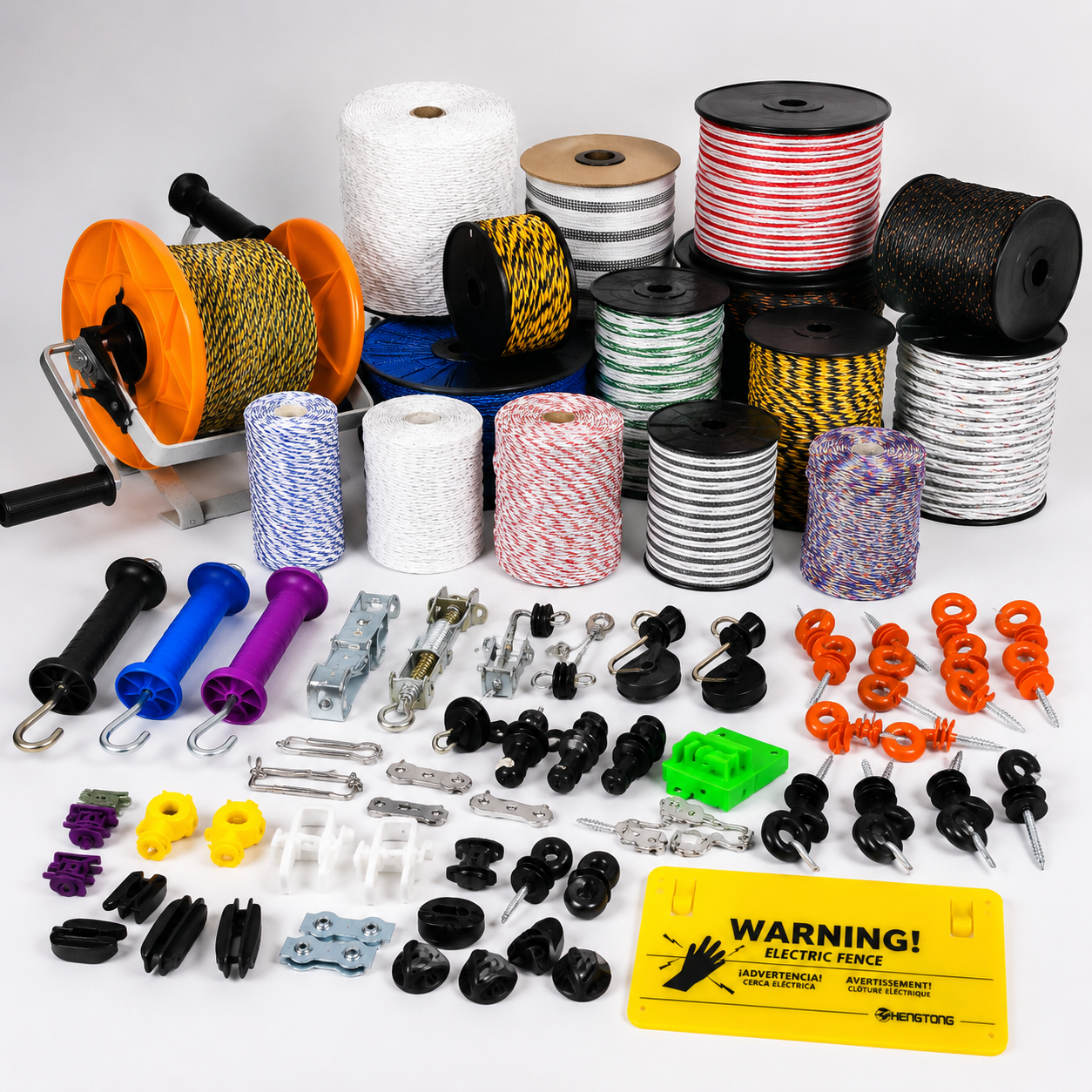
As a professional electric fencing manufacturer with over 20 years of industry experience, Hengtong supplies both 1:1 standard electric fence reels and 3:1 geared electric fence reels.
We support distributors, wholesalers, and private label brands with customized product solutions, including:
Custom reel colors
Custom branding and logos
Private label packaging
Different reel capacities
Pre-loaded electric fence conductors
Bulk production and factory-direct supply
Beyond electric fence reels, we also manufacture and supply polywire, polyrope, polytape, electric fence netting, fence posts, insulators, gate handles, and other electric fencing accessories.
Our goal is to help customers build their own complete electric fencing product range through one-stop sourcing and OEM manufacturing.
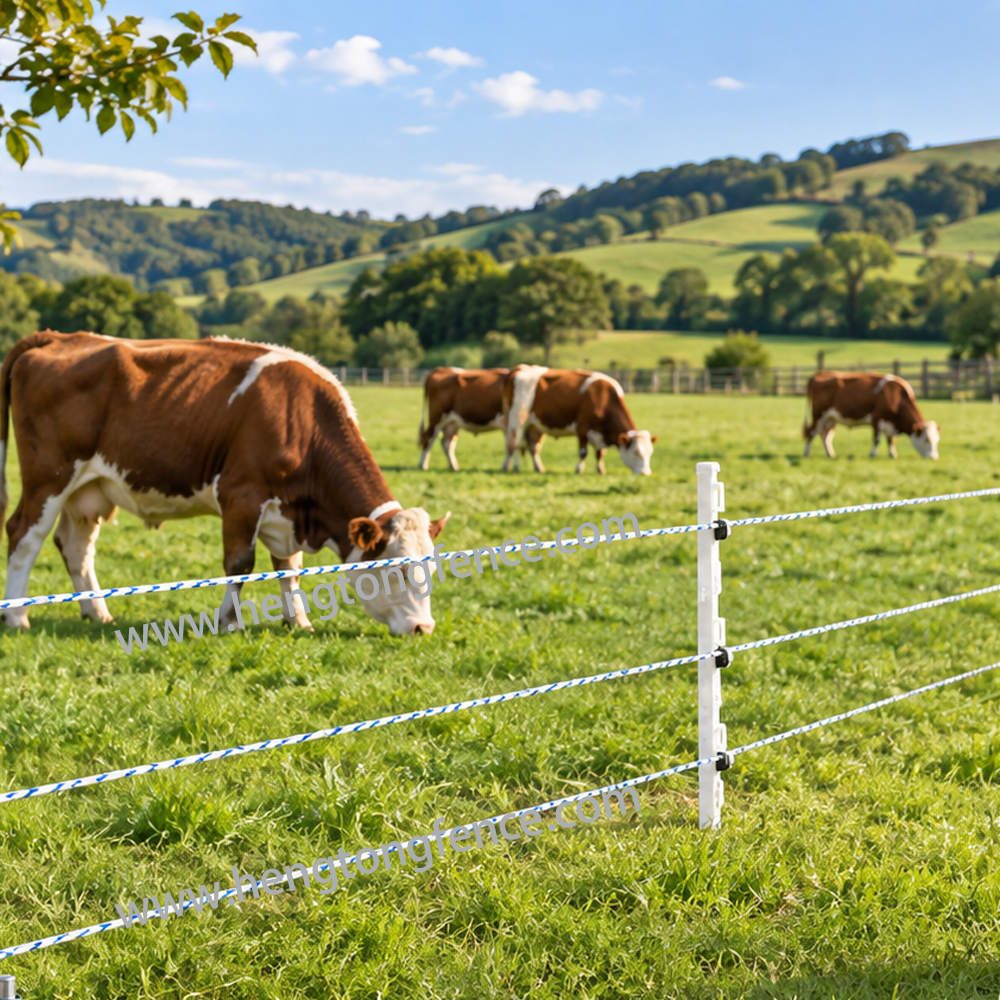
Rotational grazing is a livestock management practice that involves dividing pastureland into smaller sections, allowing animals to graze one area while other sections have time to recover.
For cattle, sheep, goats, and other grazing animals, this approach can help farmers manage pasture utilization, reduce repeated grazing of the same areas, and make better use of available land.
One of the most practical tools for rotational grazing is electric fencing. Compared with permanent fencing systems, portable electric fencing allows farmers to adjust grazing areas, move livestock, and change pasture layouts according to seasonal needs.
But what products are needed for an effective rotational grazing system, and what should farmers consider before installation?
Traditional permanent fences are useful for establishing property boundaries and long-term livestock enclosures. However, they are not always convenient when pasture divisions need to change frequently.
Portable electric fencing offers several advantages:
Flexible pasture management: Move fence lines to create different grazing areas.
Convenient installation: Temporary fencing can often be installed and removed without extensive construction.
Efficient land utilization: Divide larger pastures into smaller paddocks according to grazing requirements.
Adaptability: Adjust paddock sizes based on herd size, grass availability, and seasonal conditions.
Reusable equipment: Posts, reels, and conductors can be relocated and used in different areas.
These features make electric fencing particularly useful for rotational grazing systems where livestock are moved regularly.
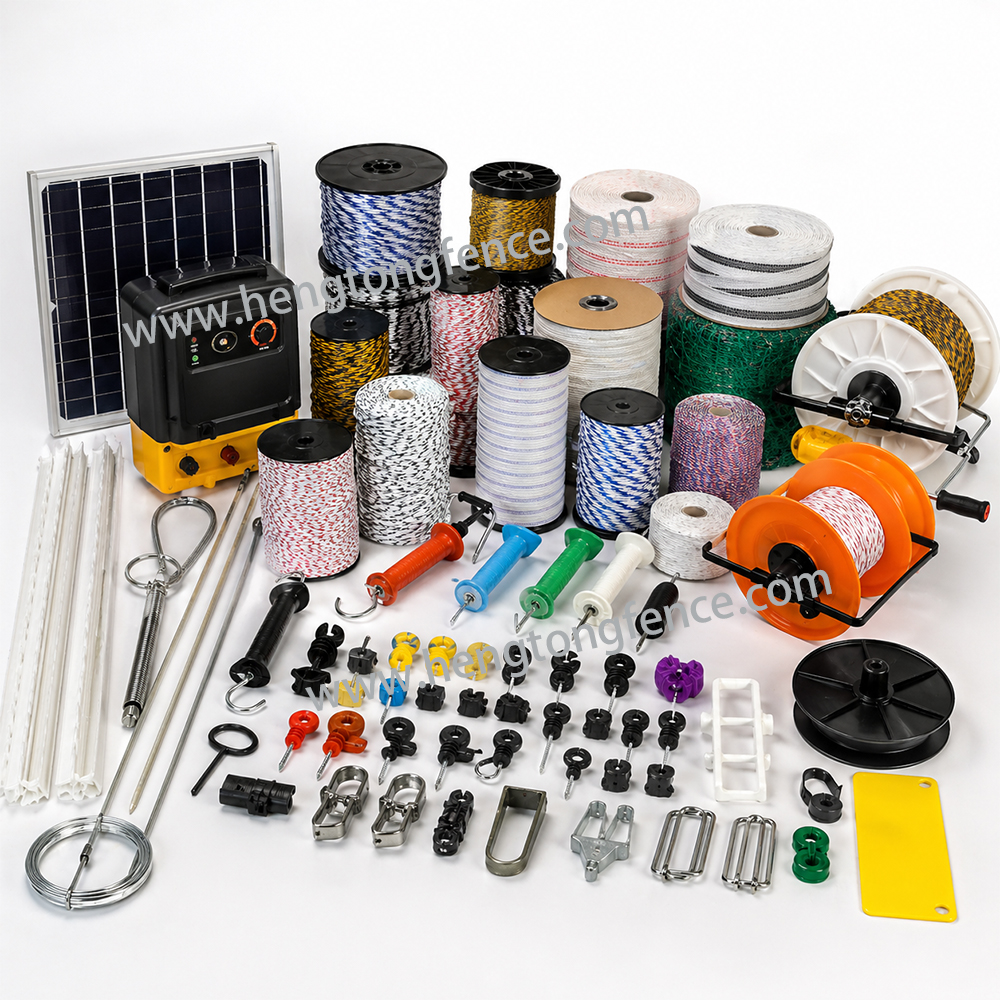
A complete portable electric fencing system requires several components working together.
Polywire is one of the most commonly used conductors for temporary electric fencing.
Its lightweight construction makes it easy to install, remove, and rewind, especially when used with portable fence reels.
Polywire is commonly used for cattle paddock divisions and other temporary fencing applications.
When choosing polywire, buyers should consider conductor material, electrical resistance, wire diameter, and intended fence length.
https://www.hengtongfence.com/products/poly-wire
Polyrope provides a thicker, more visible fencing option.
Available in different diameters and conductor configurations, it can be suitable for temporary fencing applications where additional visibility or a different handling characteristic is preferred.
The choice between polywire and polyrope depends on livestock type, fence layout, and the user’s installation preferences.
https://www.hengtongfence.com/products/poly-rope
Polytape offers greater visibility because of its flat woven structure.
It is especially useful for horses and other situations where a clearly visible fence line is important.
Common widths include 12mm, 20mm, and 40mm, although wider tape requires appropriate posts, insulators, and consideration of wind exposure.
https://www.hengtongfence.com/products/poly-tape
Portable posts allow farmers to establish temporary fence lines without permanent installation.
Common options include:
Pigtail posts
Step-in plastic posts
Fiberglass posts
Post selection depends on soil conditions, fence height, livestock type, and the conductor being used.
https://www.hengtongfence.com/products/post
Reels are particularly important for rotational grazing because fence lines are moved frequently.
They help farmers deploy, collect, and store polywire or polyrope while reducing tangling and unnecessary handling.
For distributors, reels are also a useful complementary product to offer alongside portable fence conductors.
https://www.hengtongfence.com/products/reel
An energizer supplies the electrical pulses needed for the fencing system.
Depending on the location and available power sources, farmers may use mains-powered, battery-powered, or solar-compatible energizers.
Other important components include insulators, connectors, gate handles, grounding equipment, and fence voltage testers.
Together, these products form a practical portable electric fencing system.
https://www.hengtongfence.com/products/accessories
Before installing a fence, farmers should consider how livestock will move between grazing areas.
Step 1: Evaluate the Pasture
Start by reviewing the total grazing area, available forage, water sources, access routes, and existing perimeter fences.
The number and size of paddocks will depend on livestock numbers, pasture growth, and the planned grazing schedule.
Step 2: Divide the Grazing Area
Use temporary electric fencing to divide the pasture into smaller paddocks.
Some farms use a central access lane, while others move temporary fence lines progressively across a larger field.
The layout should allow livestock to reach water and move safely between grazing sections.
Step 3: Select Suitable Conductors and Posts
For cattle, lightweight polywire and portable posts are commonly used for temporary internal divisions.
For horses, more visible conductors such as polytape may be preferable.
For sheep and goats, electric netting or appropriately designed multi-strand fencing may be more suitable, depending on the animals and the level of containment required.
Step 4: Install the Energizer and Grounding System
Choose an energizer based on the total electrified fence length, conductor resistance, vegetation contact, and livestock requirements.
Proper grounding is essential for effective electric fence performance.
The energizer should be installed according to its manufacturer’s instructions and applicable electrical safety requirements.
Step 5: Test the Fence Before Use
After installation, use a suitable electric fence tester to check voltage at different points.
Many livestock fencing applications target approximately 4,000 volts or more, but the appropriate operating voltage depends on the animals, fence design, and local conditions.
Regular testing helps identify poor connections, vegetation contact, or other causes of voltage loss.
Electrical resistance becomes increasingly important as fence length increases.
Conductors containing stainless steel, copper, or other conductive materials can offer different resistance characteristics.
For longer fence runs, selecting a suitable conductor configuration helps maintain effective voltage along the fence.
Different livestock species respond differently to fence visibility.
Horses generally benefit from highly visible fencing, while cattle can often be managed using lightweight temporary conductors once properly trained.
Rotational grazing may require fences to be moved frequently.
Lightweight conductors, portable posts, and practical reel systems can reduce the time and effort involved in repositioning fences.
Electric fence products are regularly exposed to sunlight, rain, moisture, and changing temperatures.
Material quality, UV resistance, conductor construction, and corrosion resistance should therefore be considered when selecting products for outdoor use.
Animals should be introduced to electric fencing appropriately before relying on temporary divisions.
Fence lines should be clearly positioned, properly tensioned, and regularly inspected. Energizers must be designed for electric fencing, and installations should follow applicable safety standards.
Several issues can reduce the effectiveness of a rotational grazing fence:
Choosing an energizer without considering fence length and electrical load.
Using conductors with unsuitable resistance for long fence runs.
Allowing excessive vegetation to contact electrified conductors.
Installing inadequate grounding systems.
Using posts or insulators that are incompatible with the selected conductor.
Failing to test fence voltage after installation or relocation.
Regular maintenance and appropriate product selection can help prevent these problems.
For distributors and agricultural retailers, rotational grazing creates opportunities to offer complete fencing solutions rather than individual products.
A practical product range may include polywire, polyrope, polytape, portable posts, reels, insulators, gate handles, energizers, and other accessories.
Offering compatible products together can make purchasing more convenient for customers and help distributors expand their electric fencing product categories.
At Hengtong, we manufacture a wide range of electric fencing products and support OEM and private-label customization.
Depending on the product, customers can choose different colors, lengths, diameters, conductor configurations, and packaging options to meet the requirements of their local markets.
Our goal is to help distributors and brands source reliable electric fencing products from one manufacturing partner.
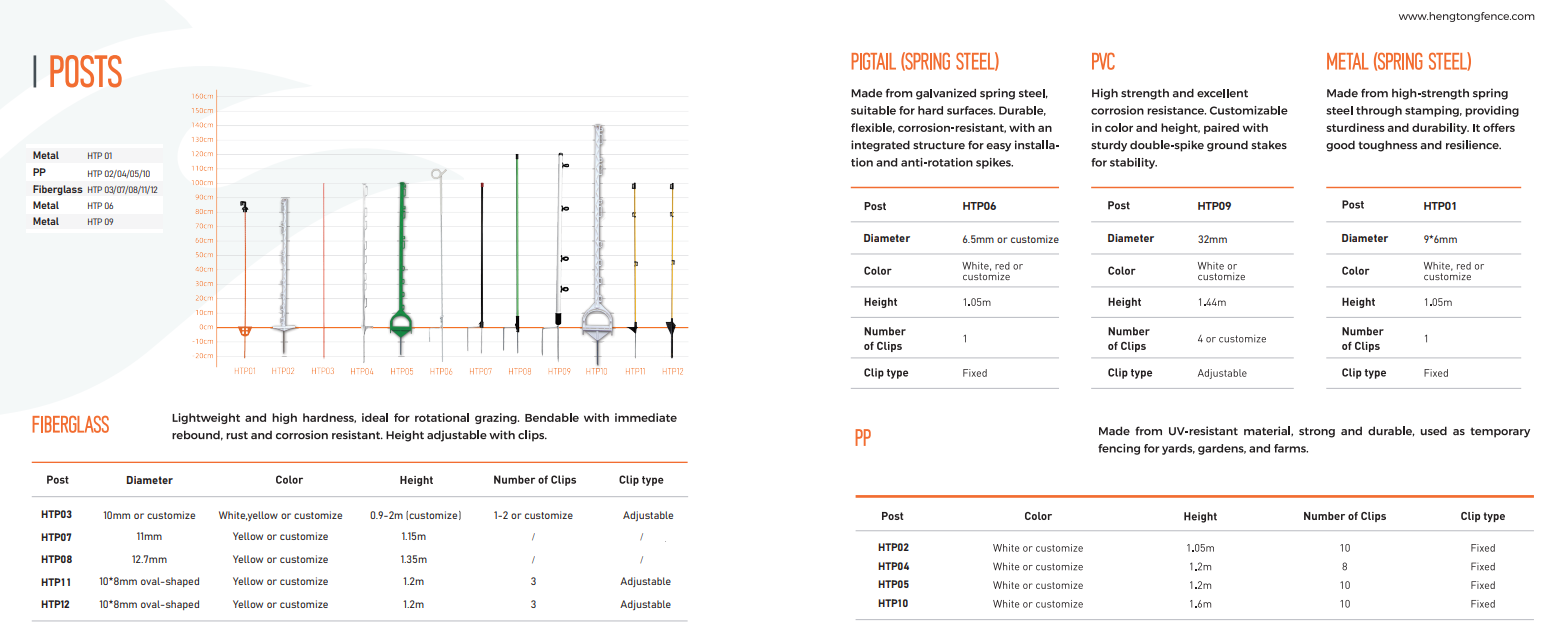
Electric fencing is widely used on farms for livestock management, pasture division, rotational grazing, and temporary fencing. While electric fence wire, rope, and tape are essential components, choosing the right electric fence posts is equally important.
Fence posts determine how well your fencing conductors are supported, how easily the fence can be installed or relocated, and how effectively the system adapts to different farm environments.
However, not all electric fence posts are designed for the same applications.
Plastic tread-in posts, fiberglass posts, and steel posts each offer different advantages depending on livestock type, soil conditions, fence height, and installation requirements.
In this guide, we’ll explain how to choose suitable electric fence posts for your farm and what to consider when purchasing fencing products for different applications.
Before selecting electric fence posts, it is important to understand the differences between the most common materials and designs.
Plastic tread-in posts are commonly used for temporary electric fencing and rotational grazing systems.
These posts typically feature a plastic body, a metal ground spike, and integrated holders designed to accommodate electric fence conductors.
Key advantages:
Lightweight and convenient to transport
Quick installation and removal
Integrated wire, rope, or tape holders on compatible designs
Suitable for temporary and movable fencing
Available in different heights and configurations
Plastic tread-in posts are particularly useful for farms where fencing layouts need to be changed regularly.
For example, farmers practicing rotational grazing may need to divide a large pasture into smaller grazing areas. Plastic tread-in posts allow fence lines to be repositioned without extensive installation work.
However, material quality is important. Posts exposed to prolonged sunlight, bending forces, and changing temperatures should be selected with appropriate outdoor performance in mind.
Fiberglass electric fence posts are another popular option for temporary and semi-permanent fencing applications.
They are generally lightweight, flexible, and suitable for supporting electric fence conductors when used with compatible clips or insulators.
Key advantages:
Lightweight construction
Good flexibility
Suitable for portable fencing systems
Different lengths available
Compatible with various conductor holders and clips
Fiberglass posts are commonly used in livestock paddocks, pasture division, and agricultural fencing.
Their flexibility can be useful where posts may experience moderate bending forces. However, the quality of the fiberglass material, surface finish, and attached components should be evaluated before purchasing.
The correct clips and conductor holders are also important for keeping the fence line at the intended height.
Steel electric fence posts provide another option for agricultural fencing installations.
Depending on their design, steel posts may be suitable for applications requiring a relatively rigid support structure.
Key advantages:
Rigid metal construction
Suitable for selected temporary or semi-permanent installations
Compatible with appropriate electric fence insulators
Available in different structural designs
Because steel conducts electricity, electric fence wires, ropes, and tapes must be kept electrically isolated from the metal post using suitable insulators.
Protective coatings and corrosion resistance should also be considered when selecting steel posts for outdoor use.
The following comparison can help farmers and fencing distributors understand the main differences between these post types.
| Feature | Plastic Tread-In Posts | Fiberglass Posts | Steel Posts |
|---|---|---|---|
| Weight | Lightweight | Lightweight | Generally heavier |
| Installation | Quick tread-in installation | Ground insertion or compatible mounting | Depends on design |
| Flexibility | Depends on plastic material and structure | Generally flexible | Relatively rigid |
| Conductor Support | Often integrated holders | Usually compatible clips | Separate insulation required |
| Portability | Excellent | Excellent | Depends on design |
| Typical Applications | Temporary fencing, rotational grazing | Portable fencing, pasture division | Selected agricultural fencing systems |
| Main Considerations | UV resistance, structural strength | Surface quality, flexibility, clips | Corrosion protection, insulation |
There is no single post type that is best for every farm.
The most suitable choice depends on the fencing system, environmental conditions, and how frequently the fence needs to be moved.
Different animals require different fencing arrangements.
Post height, conductor visibility, the number of fence lines, and spacing between posts should all be considered.
Horse fencing requires particular attention to visibility and safe fence design.
Horses should be able to recognize fence boundaries easily, especially in paddocks and grazing areas.
For this reason, wider electric fence polytape and suitable polyrope products are frequently used in horse fencing applications.
When selecting electric fence posts for horses, consider:
Sufficient post height for the intended fence layout
Compatibility with wide polytape or polyrope
Secure conductor positioning
Suitable spacing to minimize sagging
Smooth, appropriately designed components
Plastic tread-in posts and fiberglass posts can both be considered for temporary horse paddocks, depending on the fencing configuration.
For permanent horse fencing, stronger structural posts may be required at corners, ends, and high-tension points.
Electric fencing is commonly used for cattle pasture management and rotational grazing.
For movable cattle fencing systems, farmers often prioritize fast installation, convenient relocation, and compatibility with polywire or polyrope.
Plastic tread-in posts and fiberglass posts are practical options for many temporary cattle fencing arrangements.
However, the appropriate height and number of conductor lines depend on animal size, behavior, and the specific fencing application.
Sheep and goat fencing often requires careful attention to conductor spacing and fence coverage.
Depending on the application, farmers may choose multiple electric fence lines or portable electric netting.
When using individual fence posts, suitable conductor holders and sufficient support points are important for maintaining the intended fence configuration.
For portable electric netting, posts are often integrated into the netting system, which may offer a convenient alternative to installing separate conductors.
Post height is one of the most important factors when selecting electric fencing products.
Different farms require different heights based on animal species, terrain, and the number of conductor lines.
For example, some temporary fencing applications may use posts around 1.0–1.2 meters long, while taller post options may be preferred for certain horse fencing arrangements.
It is important to remember that the overall post length is not the same as the installed fence height.
Part of the post or ground spike is inserted into the soil, reducing the height available above ground.
Therefore, buyers should confirm:
Total post length
Ground spike length
Usable height above ground
Position and number of conductor holders
Compatibility with the planned fence layout
For distributors purchasing electric fence posts in bulk, offering several height options can help serve different agricultural markets.
An electric fence post should not be selected independently from the conductor it will support.
Different electric fence conductors have different physical characteristics and installation requirements.
Electric fence polywire is commonly used for portable livestock fencing and rotational grazing.
It is lightweight and convenient for temporary fence installations.
When selecting posts for polywire, check whether the integrated holders or insulators can securely support the wire diameter.
Electric fence polyrope is commonly used in horse and livestock fencing.
It is generally thicker than polywire and may require larger or differently shaped conductor holders.
Post compatibility should be checked against the rope diameter and the intended installation arrangement.
Electric fence polytape offers a wider visual profile and is frequently used for horse fencing.
Common tape widths include 12mm, 20mm, and 40mm.
Wider tape requires appropriately designed holders or insulators to maintain positioning and reduce unwanted twisting or movement.
Important: Not every electric fence post holder is suitable for every wire, rope, or tape size.
Before purchasing posts in bulk, buyers should confirm compatibility with the actual conductor specifications.
Ground conditions can significantly influence the performance of electric fence posts.
For example:
Soft soil: Posts may be relatively easy to install, but sufficient ground penetration and stability are important.
Hard or compacted soil: Installation may require additional effort, and excessive force can damage unsuitable post designs.
Rocky ground: Stones can interfere with ground spikes and may require alternative installation methods.
Wet or uneven ground: Fence alignment and post stability should be checked regularly.
For plastic tread-in posts, the ground spike is a particularly important component.
Buyers should evaluate its material, diameter, length, connection to the post body, and corrosion protection.
A well-designed post should provide a practical balance between installation convenience and structural stability.
Post spacing affects the stability, appearance, and maintenance requirements of an electric fence.
There is no universal spacing distance suitable for every installation.
The correct spacing depends on several factors:
Fence conductor type
Conductor tension
Terrain and slope
Wind exposure
Animal behavior
Fence height
Post strength and design
For example, wide polytape may require closer support spacing in windy environments to reduce movement and sagging.
On uneven ground, additional posts may be necessary to maintain consistent conductor height.
Temporary electric fencing can sometimes use wider spacing than certain permanent fencing systems, but the final arrangement should always be evaluated according to actual field conditions.
Practical tip: Begin with the post manufacturer’s installation guidance, then adjust spacing based on conductor tension, terrain, and fence stability.
Another important consideration is whether the fence will remain in one location or be moved frequently.
Temporary electric fencing is commonly used for:
Rotational grazing
Seasonal pasture division
Short-term livestock management
Portable paddocks
Temporary agricultural boundaries
For these applications, lightweight plastic tread-in posts and fiberglass posts are often practical choices.
They can be installed, removed, and repositioned relatively quickly.
Permanent electric fencing generally requires more attention to structural support, long-term exposure, and conductor tension.
Strong corner posts, end posts, and suitable tensioning systems are especially important.
Portable tread-in posts are not necessarily substitutes for properly anchored structural posts in permanent, high-tension installations.
Farmers should select a post system based on the intended service conditions rather than relying on material type alone.
For farmers and distributors, product quality should be evaluated beyond appearance and price.
Several factors deserve attention.
Outdoor fencing products are exposed to sunlight, moisture, temperature changes, and mechanical stress.
For plastic posts, UV resistance and material formulation can influence outdoor performance.
For fiberglass posts, fiber quality, resin composition, surface finish, and structural consistency are important.
For steel posts, corrosion protection and metal construction should be evaluated.
Post geometry and connection points can influence how loads are distributed.
For example, the connection between a plastic post body and its metal ground spike may experience concentrated forces during bending or installation.
Appropriate design and material selection can help improve performance under expected use conditions.
Integrated holders and detachable clips should be evaluated for:
Compatibility with conductor dimensions
Retention during normal use
Ease of installation
Resistance to expected mechanical stress
Suitable electrical insulation
For large wholesale orders, consistent dimensions, material quality, and component fit are particularly important.
Distributors should consider requesting product samples and reviewing relevant quality-control procedures before placing bulk orders.
For agricultural distributors, importers, and electric fencing brands, choosing the right post supplier involves more than comparing individual products.
A supplier offering a complete electric fencing product range can make procurement more convenient.
For example, a distributor purchasing plastic tread-in posts may also need:
Electric fence polywire
Electric fence polyrope
Electric fence polytape
Electric fence insulators
Gate handles and gate accessories
Fence reels
Electric fence connectors
Fence testers
Portable electric netting
Purchasing compatible products from one manufacturing partner can simplify product selection, supplier communication, and order coordination.
Different markets may have different preferences for post heights, colors, accessories, and packaging.
Depending on the product design and order requirements, OEM customization may include:
Post length and configuration
Plastic colors
Ground spike options
Conductor holders and clips
Customer branding
Private label packaging
For distributors developing their own electric fencing product lines, OEM manufacturing can help create a more consistent product offering.
Shandong Hengtong New Materials Co., Ltd. is an electric fencing manufacturer in China with over 20 years of OEM and ODM manufacturing experience.
Our product range includes plastic tread-in posts, fiberglass posts, steel posts, electric fence polywire, polyrope, polytape, electric netting, and a wide selection of fencing accessories.
We offer different post designs and lengths to support a variety of agricultural fencing applications.
For example, our product range includes:
Plastic tread-in posts: Models such as HTP02, HTP04, HTP05, and HTP10, with different length options.
Fiberglass posts: Multiple length options with compatible clips and ground spike configurations.
Steel tread-in posts: Additional options for selected fencing applications.
We work with international distributors, wholesalers, and fencing brands to support bulk orders, product customization, and private label supply.
Rather than sourcing electric fence posts, conductors, and accessories from multiple manufacturers, customers can discuss a complete product range with one supplier.
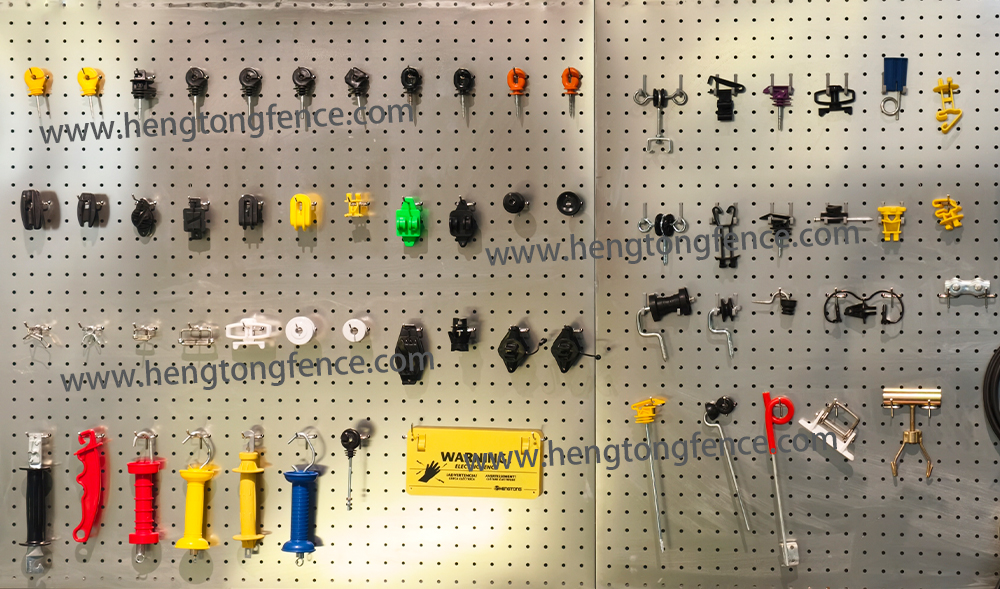
Choosing the right electric fence insulator is an important step in building an effective and reliable electric fencing system. Although insulators are relatively small components, they play an essential role in keeping conductive wires, ropes and tapes properly positioned while preventing unwanted electrical contact with fence posts.
However, not all electric fence insulators are designed for the same purpose. Different conductors, fence posts and installation conditions require different insulator designs.
Whether you are installing a new electric fence or expanding your product range as a distributor, understanding how to choose the right insulator can help improve installation efficiency and overall fence performance.
In this guide, we will explain the main factors to consider when selecting electric fence insulators.
The first step is to understand the different types of insulators available and their intended applications.
Ring insulators are commonly used with electric fence polywire and certain types of polyrope. They are generally installed on wooden or compatible fence posts using a screw-in fixing.
Their enclosed design helps keep the conductor in position while maintaining electrical isolation from the post.
Typical applications:
Polywire fencing
Light polyrope fencing
Temporary and permanent electric fences
Tape insulators are specifically designed for electric fence polytape. Their wider holding structure helps accommodate flat tape without unnecessarily twisting or damaging the conductor.
Different models are available for various tape widths, including 20 mm and 40 mm applications.
Typical applications:
Horse fencing
Paddock fencing
Livestock boundary fencing
Corner insulators are designed for fence corners and turning points, where the conductor may experience greater tension.
They help maintain conductor positioning and electrical separation at important points in the fence structure.
Typical applications:
Permanent electric fencing
Corner and end-post installations
Fence sections requiring tension management
Offset insulators extend the electric conductor away from an existing fence or post.
They are useful when an electric wire needs to be positioned separately from an existing physical fence.
Typical applications:
Existing livestock fences
Boundary protection
Offset electric fencing systems
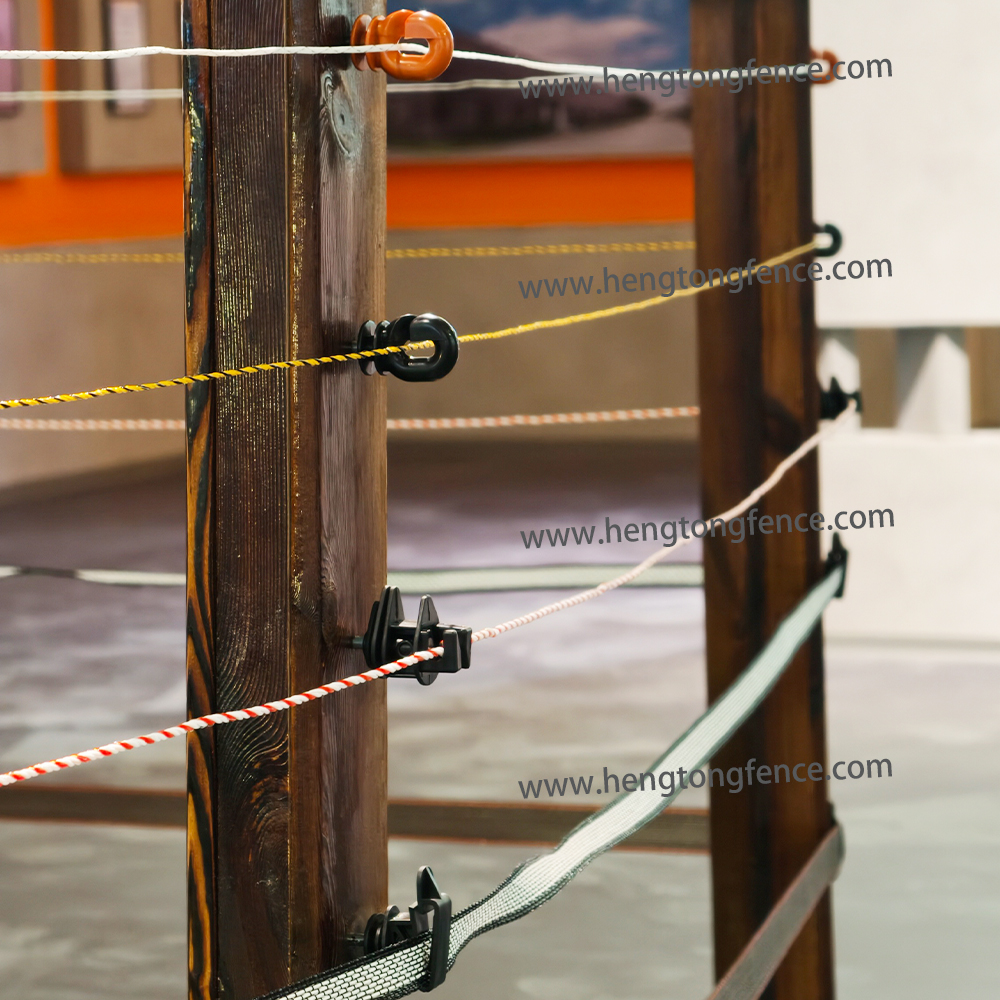
One of the most important considerations is conductor compatibility.
Electric fence systems commonly use three types of flexible conductors: polywire, polyrope and polytape. Each has a different structure and requires a suitable insulator.
| Conductor | Recommended Insulator |
|---|---|
| Polywire | Ring Insulator |
| Polyrope | Rope Insulator or Compatible Ring Insulator |
| Polytape | Tape Insulator |
| Multiple fence configurations | Suitable specialized insulators |
When choosing an insulator, pay attention to its opening size, holding structure and compatibility with the conductor diameter or width.
For example, a tape insulator designed for 40 mm polytape may not be suitable for narrower wire applications. Similarly, a small ring insulator may not provide enough space for thicker polyrope.
Choosing a compatible insulator helps prevent unnecessary friction, conductor displacement and installation difficulties.
The fence post is another important factor when selecting an insulator.
Different post materials and fixing methods require different insulator designs.
Wooden Posts
Screw-in ring insulators and other threaded insulators are commonly used on wooden posts. They can be installed directly into the post using the appropriate fixing method.
Metal Posts
Metal posts require insulators with compatible mounting systems that provide sufficient electrical separation between the conductor and the post.
Plastic and Fiberglass Posts
These posts may use specially designed clip-on, push-fit or compatible fixing insulators.
Before purchasing, check the mounting method and dimensions to ensure the insulator fits the post securely.
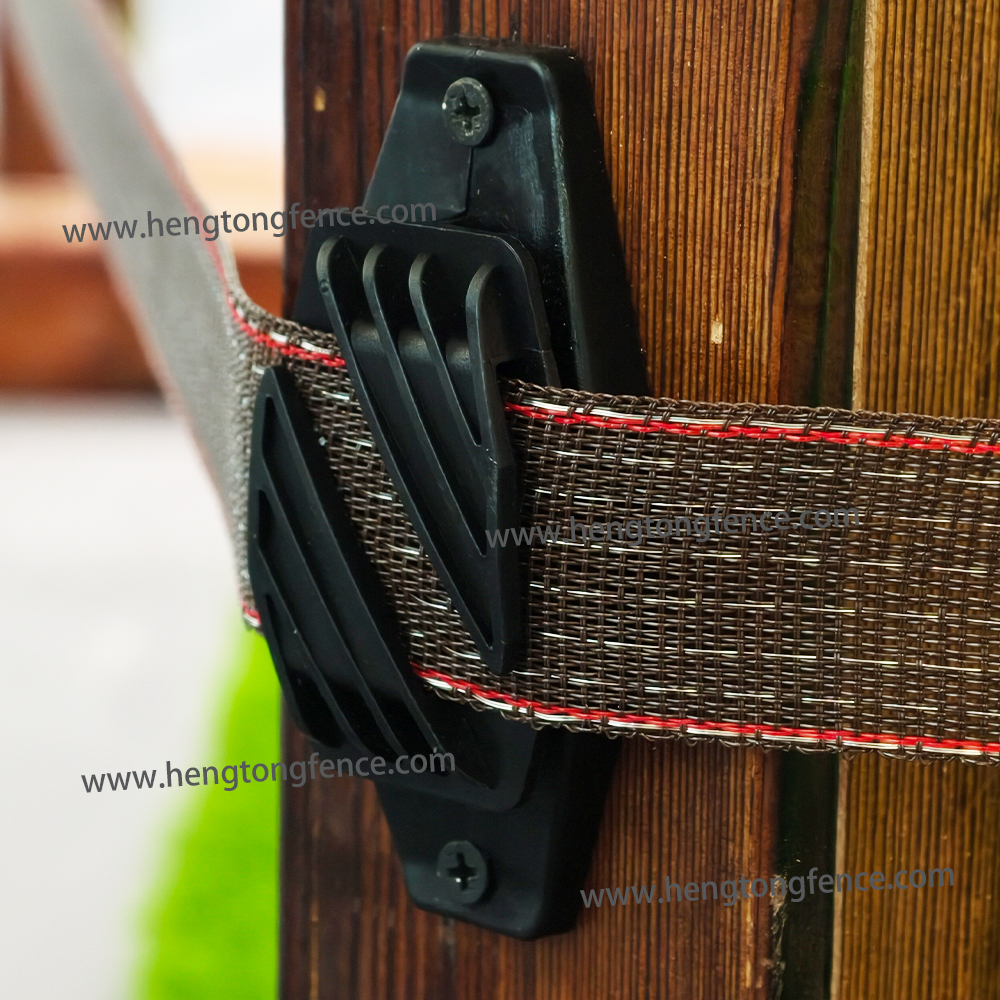
Different livestock fencing applications may require different conductor and insulator combinations.
Horse Fencing
Horse fencing commonly uses visible electric fence tape or rope. Tape insulators should match the tape width, while rope insulators should accommodate the selected rope diameter.
Cattle Fencing
Polywire and polyrope are both commonly used for cattle fencing. Ring or rope-compatible insulators can be selected according to the conductor structure.
Sheep and Goat Fencing
Polywire and electric netting are common choices depending on the fencing system. The insulator selection should match the conductor and post arrangement.
The key is to select an insulator that works with the complete fencing system rather than choosing it as an isolated accessory.
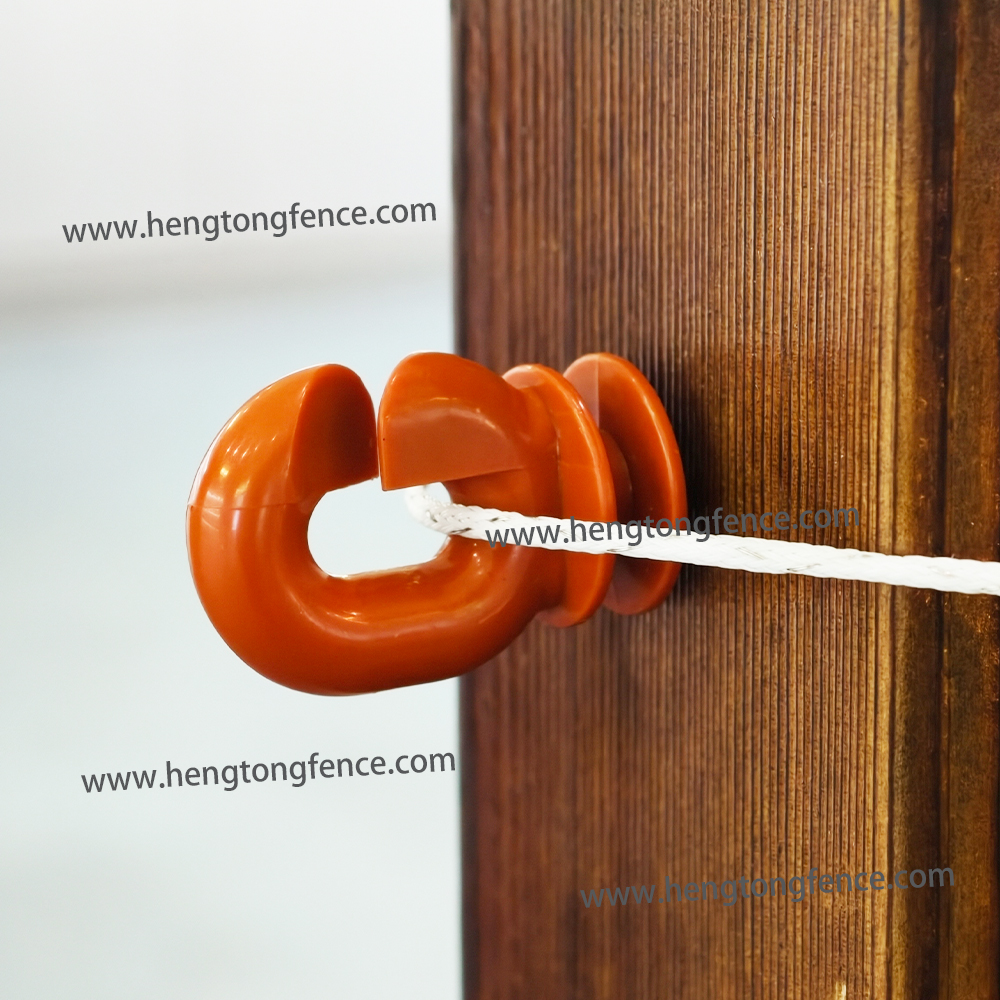
Electric fence insulators are exposed to outdoor conditions throughout the year.
Sunlight, temperature changes, rain and mechanical stress can affect their long-term performance.
When evaluating insulator quality, consider the following factors:
UV Resistance: UV-resistant materials help reduce degradation caused by prolonged sunlight exposure.
Mechanical Strength: The insulator should withstand normal installation forces and everyday outdoor use.
Electrical Insulation: The material should provide reliable separation between the energized conductor and the fence post.
Weather Resistance: Suitable materials help maintain performance under changing outdoor conditions.
For distributors, consistent product quality is particularly important because insulators are often sold as part of a complete electric fencing product range.
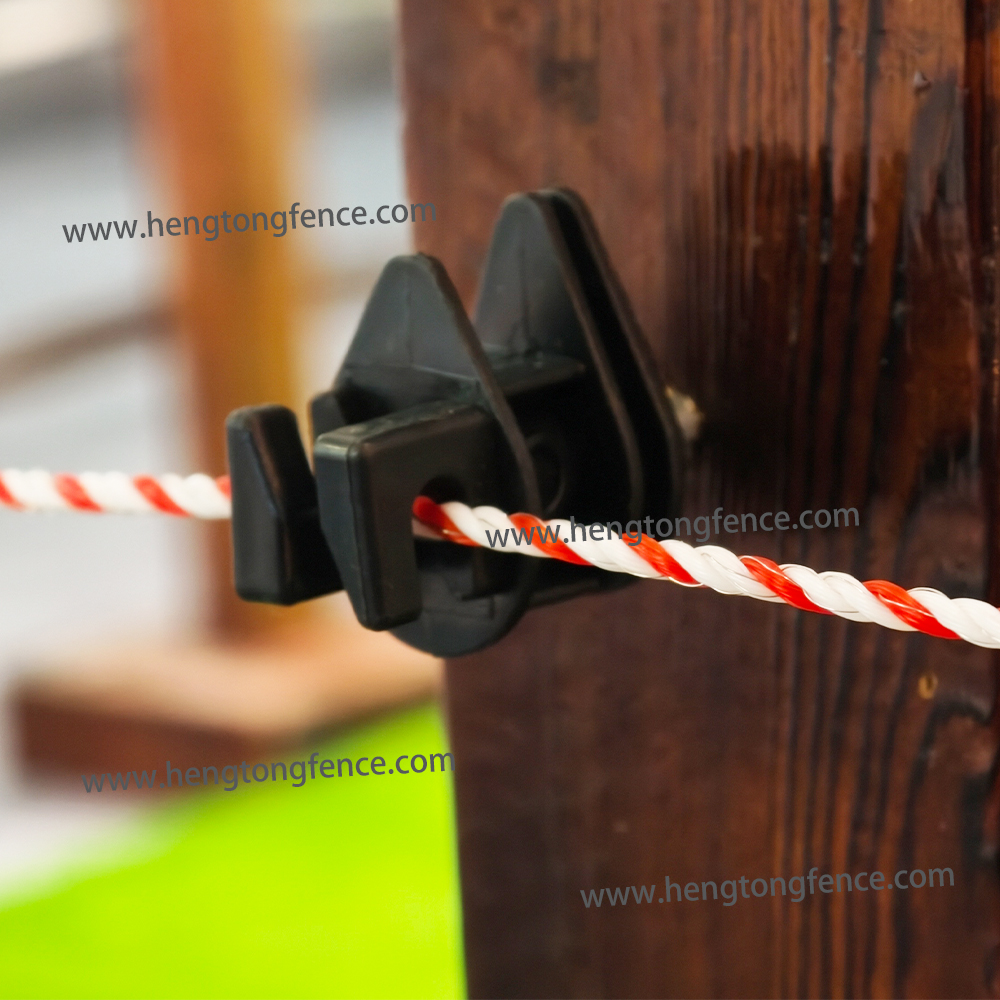
Even when the correct type of insulator is selected, some common mistakes can affect installation results.
Choosing the Wrong Size
An opening that is too small can make installation difficult, while an oversized opening may not hold the conductor properly.
Using Tape Insulators for Polywire
Different conductors have different structures. Always choose an insulator designed for the intended wire, rope or tape.
Ignoring Post Compatibility
An insulator may be suitable for the conductor but incompatible with the fence post or mounting method.
Overlooking Outdoor Durability
Insulators are exposed to weather throughout their service life. Material quality and UV resistance should be considered before purchasing.
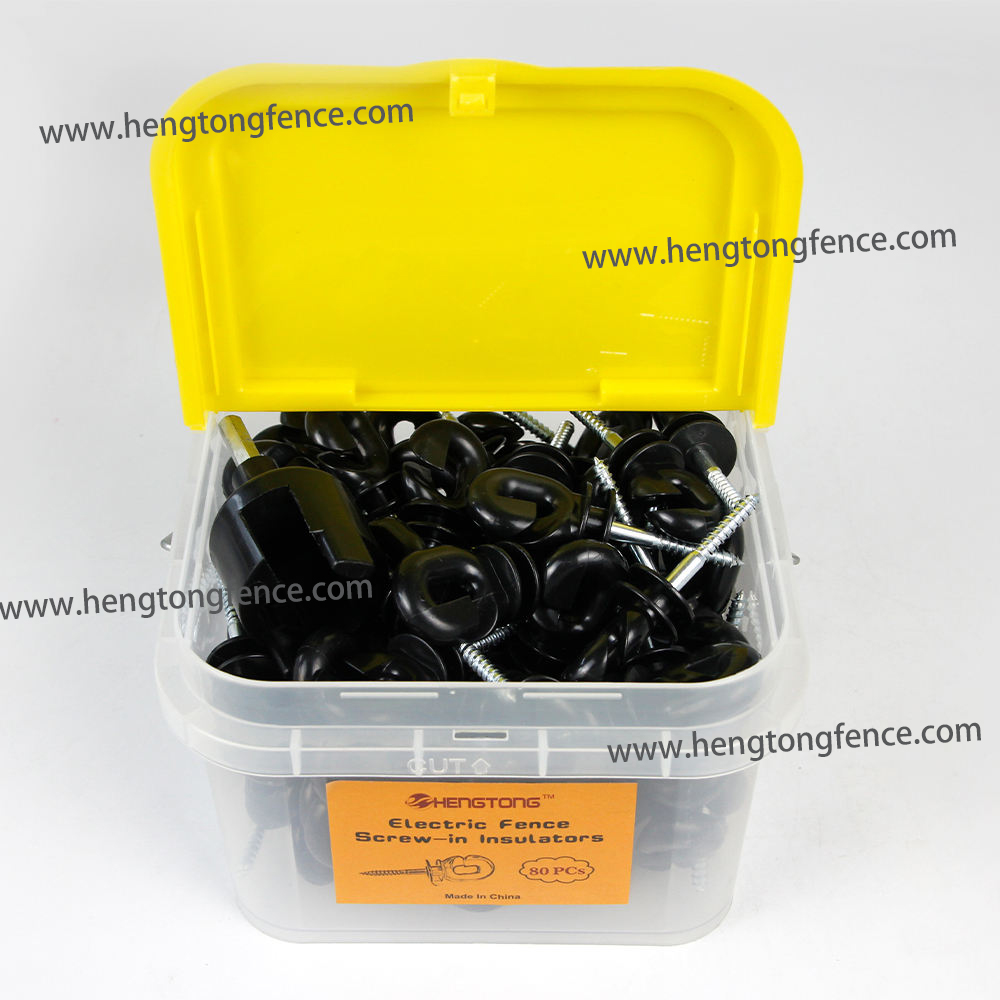
For electric fence distributors and wholesalers, offering a variety of compatible insulators can help meet the needs of different customer groups.
A practical product range may include:
Ring insulators for polywire
Rope insulators for polyrope
Tape insulators for different tape widths
Corner insulators for fence turning points
Offset insulators for existing fence structures
Threaded insulators for compatible mounting systems
Combining these products with polywire, polyrope, polytape, fence posts, gate handles and other accessories allows distributors to offer more complete electric fencing solutions.
As a manufacturer specializing in electric fencing products, Shandong Hengtong New Materials Co., Ltd. provides a range of electric fence conductors and compatible accessories for international distributors and wholesalers.
We also support OEM and private-label customization to help our partners develop product ranges suited to their local markets.
Choosing the right electric fence insulator depends on several factors, including conductor type, post material, installation position, animal application and outdoor durability.
The most important rule is simple: match the insulator to the conductor and the fence structure.
With the right combination of polywire, polyrope, polytape and compatible insulators, distributors can provide customers with practical and reliable electric fencing solutions.
Looking for electric fence insulators and compatible fencing products for your market?
Contact Shandong Hengtong New Materials Co., Ltd. to explore our product range and OEM customization options.
Electric fence netting is a practical solution for livestock management, temporary enclosures, and rotational grazing. Whether you are raising sheep, goats, chickens, ducks, or other poultry, choosing the right electric fence netting and installing it correctly are essential for effective fencing.
Compared with permanent fencing systems, portable electric fence netting can be installed, removed, and relocated according to changing pasture conditions and livestock management requirements.
At Hengtong, we manufacture different types of electric fence netting and provide matching installation accessories to help customers set up their fencing systems.
In this guide, we will explain how to choose suitable electric fence netting, what accessories are included, and how to install the netting step by step.
Before installation, the first step is selecting electric fence netting suitable for your livestock.
Different animals have different sizes, behaviors, and fencing requirements. Therefore, fence height, mesh size, and overall structure should be considered before purchasing.
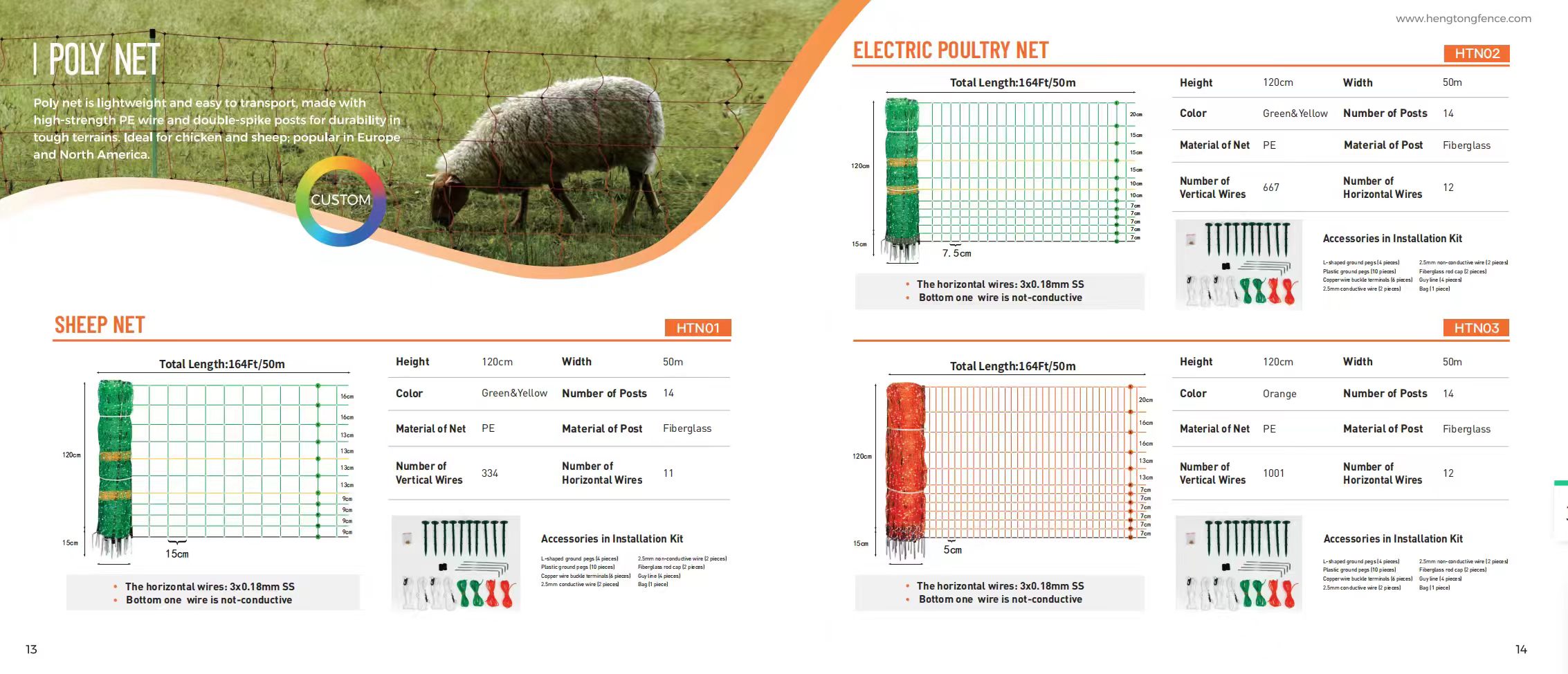
Electric sheep netting is commonly used for sheep grazing, pasture management, and temporary livestock enclosures.
It helps farmers establish flexible grazing areas and relocate their fences when necessary.
When choosing sheep netting, consider the height, mesh configuration, total fence length, and post structure.
For example, one of our sheep netting configurations features:
Height: 120 cm
Length: 50 m
Color: Green and yellow
Material: PE
Posts: 14 fiberglass posts
Horizontal strands: 11
Vertical strands: 334
Mesh spacing: Approximately 15 cm horizontally, with varying vertical spacing
The horizontal conductive strands incorporate stainless steel conductors, while the bottom strand is non-conductive.
Other specifications can be discussed according to different market requirements.
Electric poultry netting is designed for chickens, ducks, and other poultry applications.
Compared with some sheep netting configurations, poultry netting may use smaller mesh openings to help reduce the risk of birds passing through the fence.
For example, our electric poultry netting options include:
HTN02 Poultry Netting
Height: 120 cm
Length: 50 m
Color: Green and yellow
Posts: 14 fiberglass posts
Horizontal strands: 12
Vertical strands: 667
Mesh spacing: Approximately 7.5 cm horizontally
HTN03 Poultry Netting
Height: 120 cm
Length: 50 m
Color: Orange
Posts: 14 fiberglass posts
Horizontal strands: 12
Vertical strands: 1001
Mesh spacing: Approximately 5 cm horizontally
Both designs provide different mesh configurations for poultry fencing applications.
Besides sheep and chickens, electric fence netting may also be used for goats and other livestock, depending on the selected design and animal requirements.
For different markets, buyers can choose suitable netting heights, lengths, colors, mesh configurations, and post designs.
Choosing the right netting is the foundation of a properly installed electric fence system.
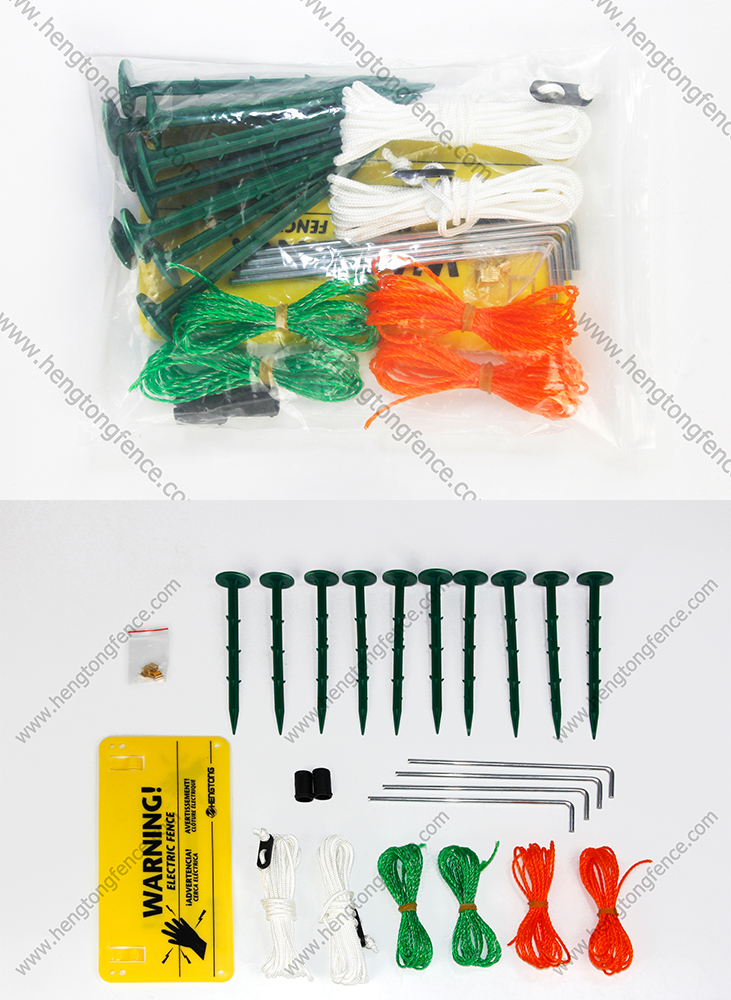
After selecting the appropriate electric fence netting, the next step is to check the installation accessories.
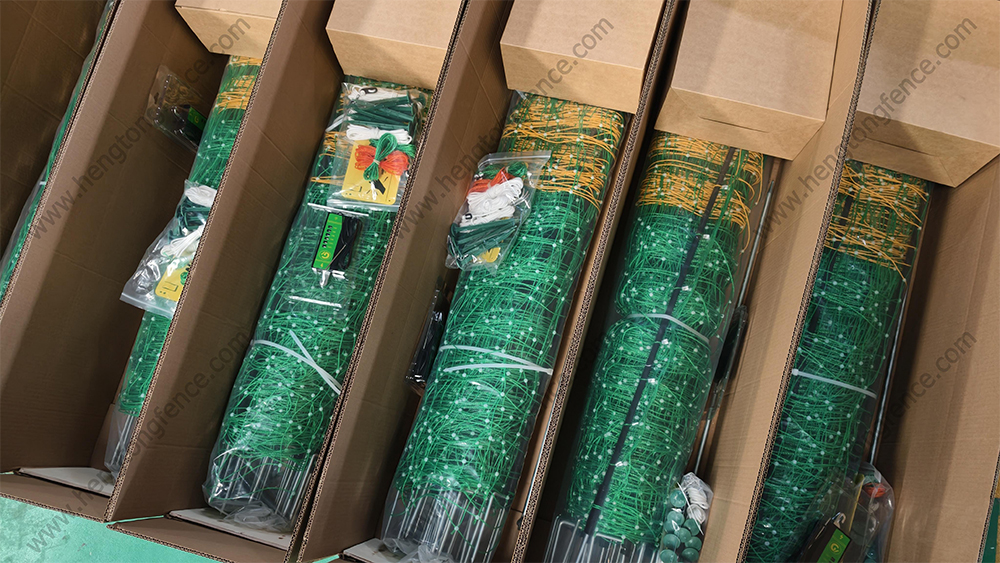
At Hengtong, our electric fence netting products are supplied with matching accessory kits designed to support installation.
Depending on the netting model, an installation kit may contain:
Ground pegs for securing the fence
L-shaped metal ground pegs
White connecting or securing ropes
Green and orange support ropes
Rope clips and buckles
Metal connectors
A warning sign
Other small installation components
These accessories are used for securing the netting, connecting fence sections, reinforcing the structure, and supporting installation.
The exact accessory quantities and configurations may vary depending on the netting specifications.
Before beginning installation, open the accessory package and arrange the components so they are easy to identify and use.
This simple preparation helps make the following installation steps more organized.
Start by choosing a suitable installation area based on your livestock enclosure requirements.
Clear away large obstacles, sharp objects, and excessive vegetation that could interfere with the netting.
Next, carefully unfold the electric fence netting and lay it flat on the ground along the planned fence line.
As you unfold the netting:
Locate the first fiberglass post.
Extend the netting gradually along the ground.
Arrange the integrated fiberglass posts in sequence.
Keep the mesh straight and avoid tangling the strands.
Check that the netting is facing the correct direction.
Do not pull the netting forcefully, as this may place unnecessary stress on the mesh connections.
Installation tip: Laying the entire netting section flat before inserting the posts makes it easier to identify the fence layout and maintain the correct spacing.
Once the netting is unfolded, position the fiberglass posts along the planned fence line.
The posts should be arranged in their original sequence to maintain the netting’s structure.
Before inserting them into the ground, check the following:
The posts are correctly aligned.
The netting is not twisted.
The mesh is evenly distributed between adjacent posts.
The fence follows the intended enclosure shape.
The starting and ending posts are positioned correctly.
For rectangular or irregularly shaped enclosures, pay particular attention to corners and changes in direction.
Proper post arrangement helps the netting remain upright after installation.
After positioning the posts, begin installing them one by one.
Starting from the first post, carefully insert the post spikes into the ground.
Continue along the fence line until all posts are installed.
During installation:
Hold each post upright.
Position its spike at the intended installation point.
Press the spike firmly into the soil using the method recommended for the post.
Check that the post remains vertical.
Continue to the next post while maintaining the netting’s alignment.
The posts should be firmly inserted to reduce unnecessary movement.
Avoid forcing posts into rocks or extremely hard ground, as this could damage the spikes or fiberglass components.
Where necessary, prepare the ground or adjust the installation position.
Once all posts are installed, walk along the fence line and check that the structure remains stable.
After the main fence structure is installed, the starting and ending posts need to be properly secured.
For a closed enclosure, position the final post next to the first post.
Use the supplied securing rope or compatible fastening components to hold the posts together.
Where the netting design includes a metal connector, use it to connect the appropriate conductive connection points.
Follow these steps:
Bring the starting and ending posts into position.
Align the netting edges.
Secure the posts using the supplied rope or fastening components.
Connect the designated conductive sections with the appropriate metal connector.
Check that the connection is secure and does not create a short circuit.
Make sure the fence remains properly aligned after connecting the ends.
Important: Mechanical fastening and electrical connection serve different purposes. The posts must be physically secured, while the conductive strands must be connected according to the netting’s electrical design.
To improve stability, additional support ropes can be installed where required.
This is particularly useful at corners, fence ends, or locations exposed to wind.
The accessory kit includes ropes and ground-fixing components that can be used for additional support.
To install the support ropes:
Identify the posts that require additional support.
Attach the support rope to the appropriate post connection point.
Extend the rope outward at a suitable angle.
Position a ground peg away from the fence.
Insert the peg securely into the ground.
Attach the rope to the peg using the supplied clip or buckle.
Adjust the rope tension until the post is properly supported.
Avoid overtightening the rope, which could cause the post to bend excessively or distort the netting.
The goal is to maintain an upright, stable fence structure.
After installing the support ropes, secure the remaining ground pegs where necessary.
The pegs help stabilize the fence and hold selected sections closer to the ground.
If the bottom of the netting is slightly elevated, use suitable pegs to secure the non-conductive lower section according to the product instructions.
Installation procedure:
Identify sections where the netting is raised above the ground.
Position a suitable ground peg.
Secure the designated non-conductive section of the netting.
Insert the peg firmly into the soil.
Repeat where necessary.
Inspect the entire fence line for excessive gaps or sagging.
Do not allow metal pegs to contact conductive strands.
When installation is complete, the netting should be upright, reasonably tensioned, and properly supported.
After completing the mechanical installation, connect the electric fence netting to a compatible electric fence energizer.
The energizer supplies controlled electrical pulses through the conductive fence strands.
Before connecting the system, ensure the energizer is switched off.
Then:
Position the energizer in a suitable location.
Install the grounding system according to the energizer manufacturer’s instructions.
Connect the energizer’s fence output to the designated conductive connection point.
Check that all electrical connections are secure.
Ensure conductive strands are not touching the soil, metal ground pegs, or surrounding vegetation.
Switch on the energizer after completing the installation.
The appropriate energizer depends on the total netting length, the number of connected sections, vegetation conditions, and livestock requirements.
Never connect electric fence netting directly to household mains electricity.
Follow applicable electrical safety regulations and the manufacturer’s instructions.
The final step is to check the completed fencing system.
Use a suitable electric fence voltage tester to verify that the netting is operating correctly.
Check the voltage at different points along the fence, particularly at locations farthest from the energizer.
If the voltage is lower than expected, inspect the system for:
Loose electrical connections
Vegetation touching conductive strands
Inadequate grounding
Damaged mesh or conductors
Conductive strands touching the ground
An energizer that is unsuitable for the connected fence load
Also inspect the physical fence structure to make sure the posts, ropes, and ground pegs remain secure.
Only introduce livestock after confirming that the fence is properly installed and functioning as intended.
Even a well-designed electric fence netting system requires proper installation.
Here are some common mistakes to avoid.
Twisted or tangled mesh can make installation difficult and affect the fence structure.
Always unfold the netting and arrange the posts before installation.
Posts that are not firmly inserted may lean or shift during use.
Make sure each post is properly secured.
Corners and exposed areas may require additional support.
Use the supplied support ropes and ground pegs where necessary.
Electrical contact with the soil or vegetation can reduce fence voltage.
Keep conductive strands clear of unwanted contact.
A fence may appear correctly installed while having insufficient electrical output.
Always check its operation with an appropriate voltage tester.
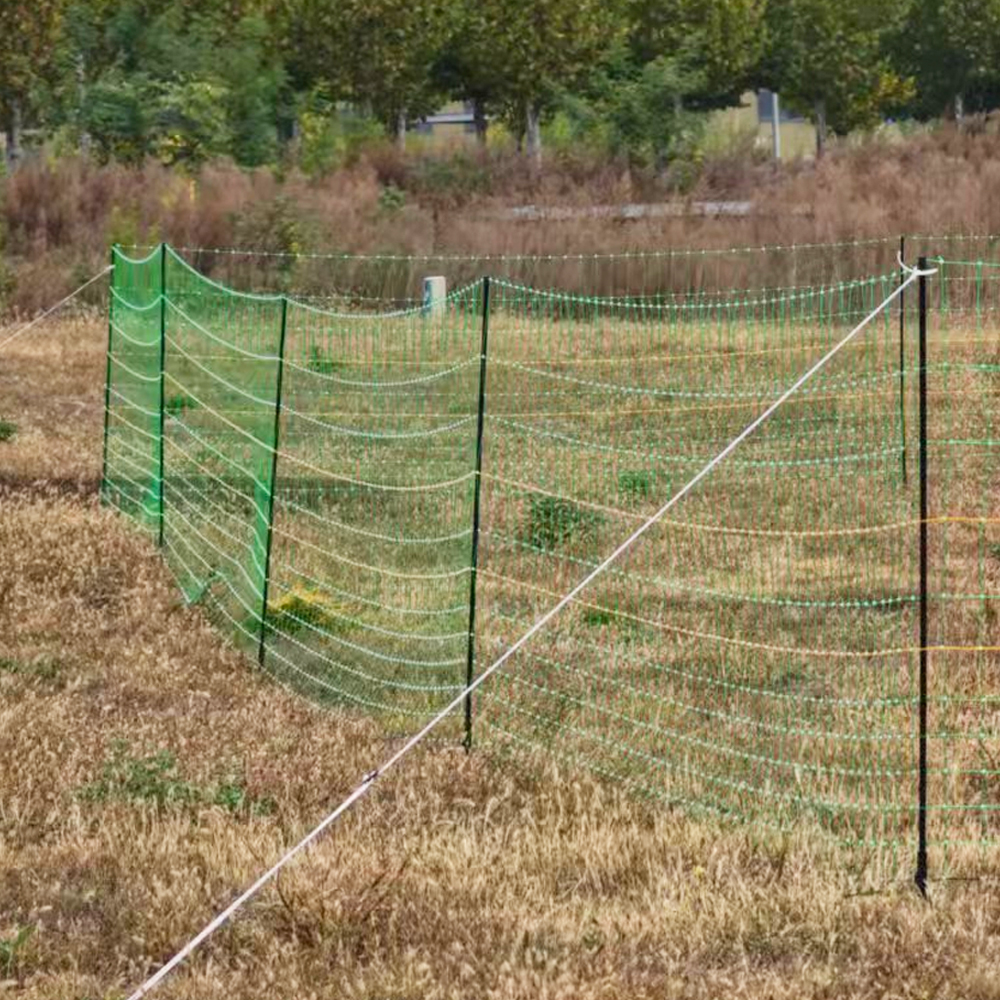
Regular inspection helps maintain the performance of portable electric fence netting.
Check the netting periodically for damaged strands, loose posts, excessive vegetation, and insecure electrical connections.
After strong winds or heavy rainfall, inspect the support ropes and ground pegs.
When relocating the fence, switch off and disconnect the energizer before removing the netting.
Carefully remove the ground pegs, release the support ropes, and gather the fiberglass posts in sequence.
Fold or roll the netting neatly to prevent tangling during storage and transportation.
Store the netting and accessories in a clean, dry location when not in use.
Choosing a suitable electric fence netting supplier is important for distributors, wholesalers, and agricultural equipment brands.
As a manufacturer of electric fence products, Shandong Hengtong New Materials Co., Ltd. provides electric fence netting and matching installation accessories for international markets.
We understand that different countries and customers have different requirements for livestock fencing products.
That is why we support OEM customization according to specific market needs.
Our electric fence netting can be customized in several aspects, including:
Height: Different netting heights for different livestock applications.
Length: Different roll lengths according to customer requirements.
Mesh Configuration: Different mesh openings and horizontal or vertical strand arrangements.
Colors: Customized netting colors for different markets and branding preferences.
Post Design: Different fiberglass post configurations according to product requirements.
Packaging: Customized packaging solutions and private-label branding.
In addition to electric fence netting, we also supply matching installation accessories.
This allows customers to source the netting and its related accessories together, simplifying product purchasing and distribution.
Whether you are an established electric fence distributor or planning to introduce your own private-label fencing products, we can discuss product specifications, customization options, and bulk manufacturing requirements.
Our goal is to help customers develop electric fence netting products suitable for their local markets.
Installing electric fence netting becomes more straightforward when the correct product and installation accessories are prepared in advance.
From choosing suitable sheep or poultry netting to unfolding the mesh, securing the fiberglass posts, installing support ropes, and testing the electrical system, each step contributes to the stability and operation of the fence.
For distributors and agricultural equipment suppliers, choosing a manufacturer that provides both electric fence netting and matching accessories can also simplify sourcing.
Looking for an OEM electric fence netting manufacturer?
Contact Hengtong to learn more about our sheep netting, poultry netting, customization options, and wholesale manufacturing services.
Solar electric fence energizers have become an increasingly popular solution for livestock management, rotational grazing, and temporary electric fencing systems. By combining solar energy with battery storage, these devices provide electric fence pulses in locations where access to mains electricity is limited or unavailable.
Whether you are managing cattle, sheep, horses, or other livestock, choosing the right solar electric fence energizer is essential for maintaining effective fence performance.
In this guide, we explain how solar electric fence energizers work, their main advantages, how to select the right model, and how to install and maintain them correctly.
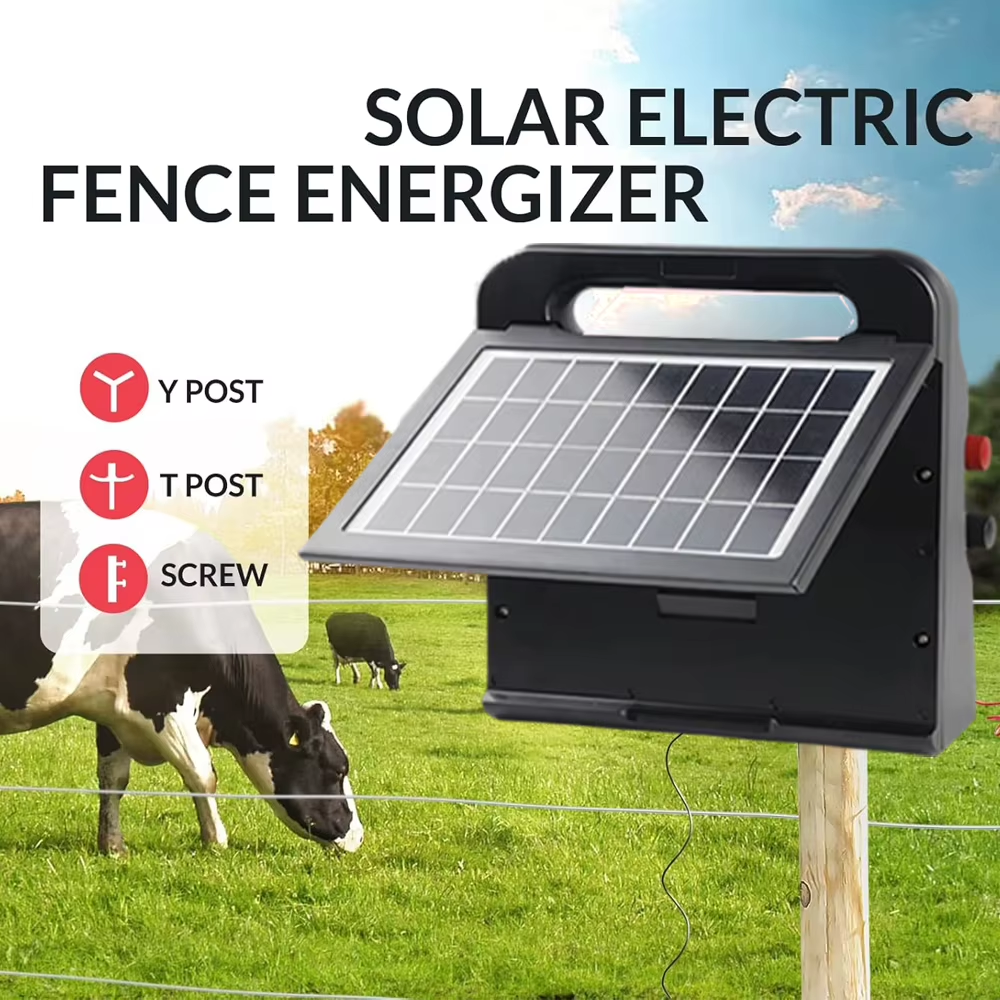
A solar electric fence energizer is a device that uses energy collected from sunlight to power an electric fencing system.
Unlike conventional mains-powered energizers, solar-powered models can operate independently of the electrical grid, making them particularly suitable for remote farms, pastures, and portable fencing applications.
A typical solar electric fence energizer system consists of several essential components:
Solar Panel: Converts sunlight into electrical energy.
Rechargeable Battery: Stores energy for nighttime operation and periods of limited sunlight.
Energizer Unit: Converts stored electrical energy into short, high-voltage pulses.
Fence Terminal: Connects the energizer to the conductive fence line.
Earth Terminal: Connects the energizer to the grounding system.
The energizer sends brief electrical pulses through the conductive fence wires. When an animal touches the energized fence while providing a path to earth, it receives a short electric shock that encourages it to stay within the designated area.
This makes solar electric fencing a practical solution for livestock containment and pasture management.
Off-Grid Operation
One of the main advantages of solar electric fence energizers is their ability to operate without a permanent mains electricity connection.
This is especially useful for remote pastures, temporary grazing areas, and agricultural land where installing electrical infrastructure would be expensive or impractical.
Reduced Operating Electricity Costs
Solar panels collect renewable energy from sunlight, reducing dependence on purchased grid electricity. However, batteries and other components may still require maintenance or replacement.
Suitable for Portable Fencing
Many compact solar energizers are designed for portable electric fencing systems.
They can be used together with polywire, polytape, polyrope, portable fence posts, and suitable insulators, making them useful for rotational grazing.
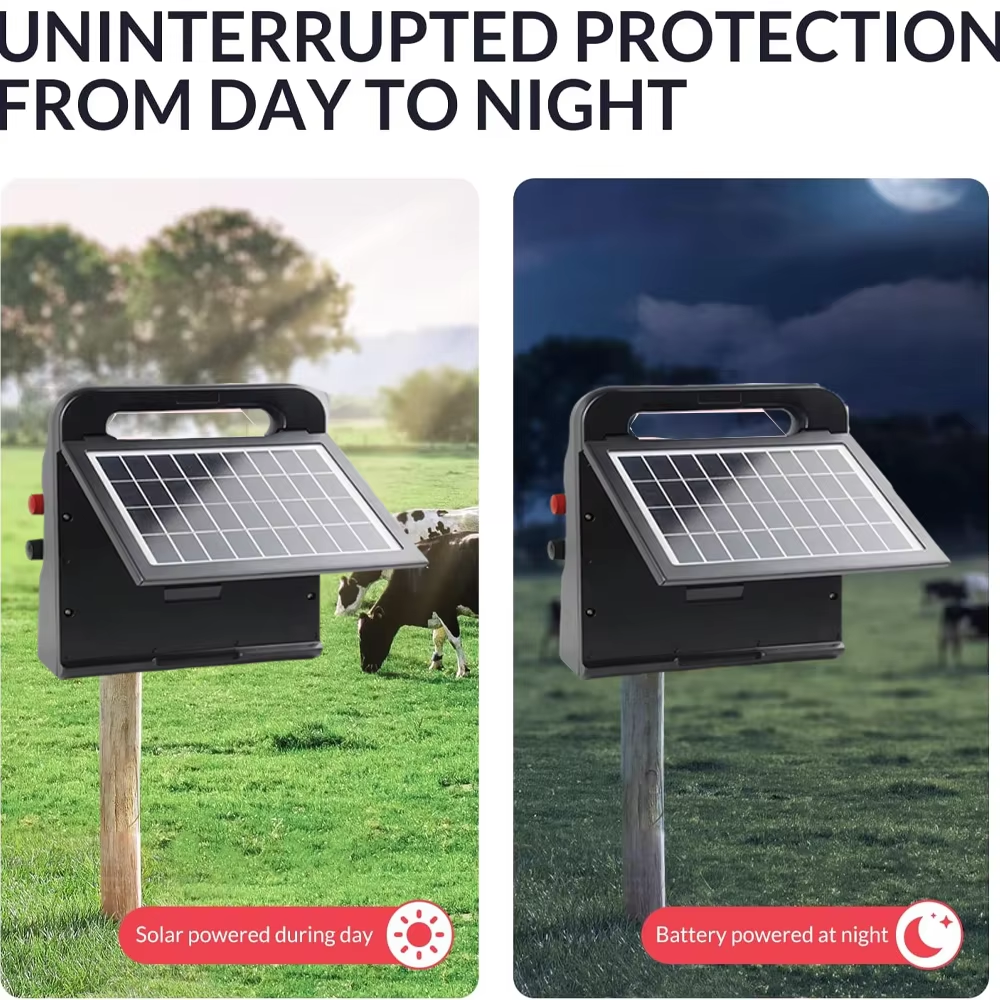
Day and Night Operation
When correctly sized and equipped with a suitable battery, a solar energizer can continue operating at night and during periods of reduced sunlight.
The available operating time depends on battery capacity, energizer consumption, solar panel output, and local weather conditions.
Choosing a solar electric fence energizer involves more than simply comparing advertised fence lengths.
Several technical factors should be considered before purchasing.
One of the most important specifications is output energy, usually measured in joules (J).
Output energy indicates the electrical energy delivered in each fence pulse under specified test conditions.
In general, larger or more demanding fencing systems require higher output energy.
|
Output energy |
General application |
|---|---|
|
Below 0.5 J |
Small, well-maintained temporary fencing |
|
0.5–1 J |
Short portable livestock fences |
|
1–3 J |
Medium-sized grazing systems |
|
Above 3 J |
More demanding or extensive fencing systems |
These are general orientation ranges, not guaranteed fence-length ratings. Actual requirements depend on fence resistance, vegetation, grounding, animal type, and installation conditions.
When comparing energizers, buyers should distinguish between stored energy and output energy. These specifications are not interchangeable.
The total length of conductive fencing connected to the energizer is another important consideration.
For example, a pasture with a 500-meter perimeter and three energized strands contains approximately 1,500 meters of conductor.
A longer fence, additional strands, poor electrical connections, and vegetation touching the fence can all increase the load on the energizer.
Manufacturers may advertise maximum fence lengths under ideal conditions. Actual operating distances can be significantly shorter.
For practical selection, consider the entire fence system rather than perimeter distance alone.
A solar electric fence energizer needs sufficient solar generation and battery capacity to operate reliably.
When comparing models, consider:
Solar panel rated power (W)
Battery voltage and capacity (V and Ah)
Energizer energy consumption
Expected daily sunlight
Required operating time during cloudy weather
Local seasonal conditions
For example, a solar panel suitable for a sunny region may not provide sufficient charging performance during winter in an area with limited sunlight.
The solar panel and battery should be sized together based on the energizer’s actual power requirements.
Different livestock applications can require different fencing arrangements.
Cattle: Often respond well to properly installed electric fencing, particularly when trained to respect the fence.
Sheep: Their wool can reduce electrical contact, making fence design, conductor placement, and adequate voltage especially important.
Horses: Highly visible conductors such as polytape are often preferred to help horses recognize the fence boundary.
Goats: Their agility and tendency to test fencing can require additional strands, careful spacing, and consistent fence performance.
For wildlife exclusion, such as wild boar protection, fence design and energizer selection should account for animal behavior, terrain, and local conditions.
The energizer is only one component of a complete electric fencing system.
The conductor material also affects how efficiently electrical pulses travel along the fence.
Common options include:
|
Conductor |
Main characteristics |
Common applications |
|---|---|---|
|
Polywire |
Lightweight, flexible, easy to install |
Portable fencing, rotational grazing |
|
Polytape |
Wide, highly visible design |
Horse fencing, temporary boundaries |
|
Polyrope |
Thicker construction, good visibility |
Livestock paddocks, semi-permanent fencing |
|
Electric Netting |
Integrated mesh structure |
Sheep, poultry, goats and temporary enclosures |
Conductive materials may contain stainless steel, copper, aluminum, or combinations of different metal conductors.
The number, diameter, and material of these conductors influence electrical resistance.
Lower-resistance conductors generally help maintain fence voltage over longer distances, especially in larger installations.
For distributors, offering different conductor specifications allows customers to select products suited to their local market requirements.
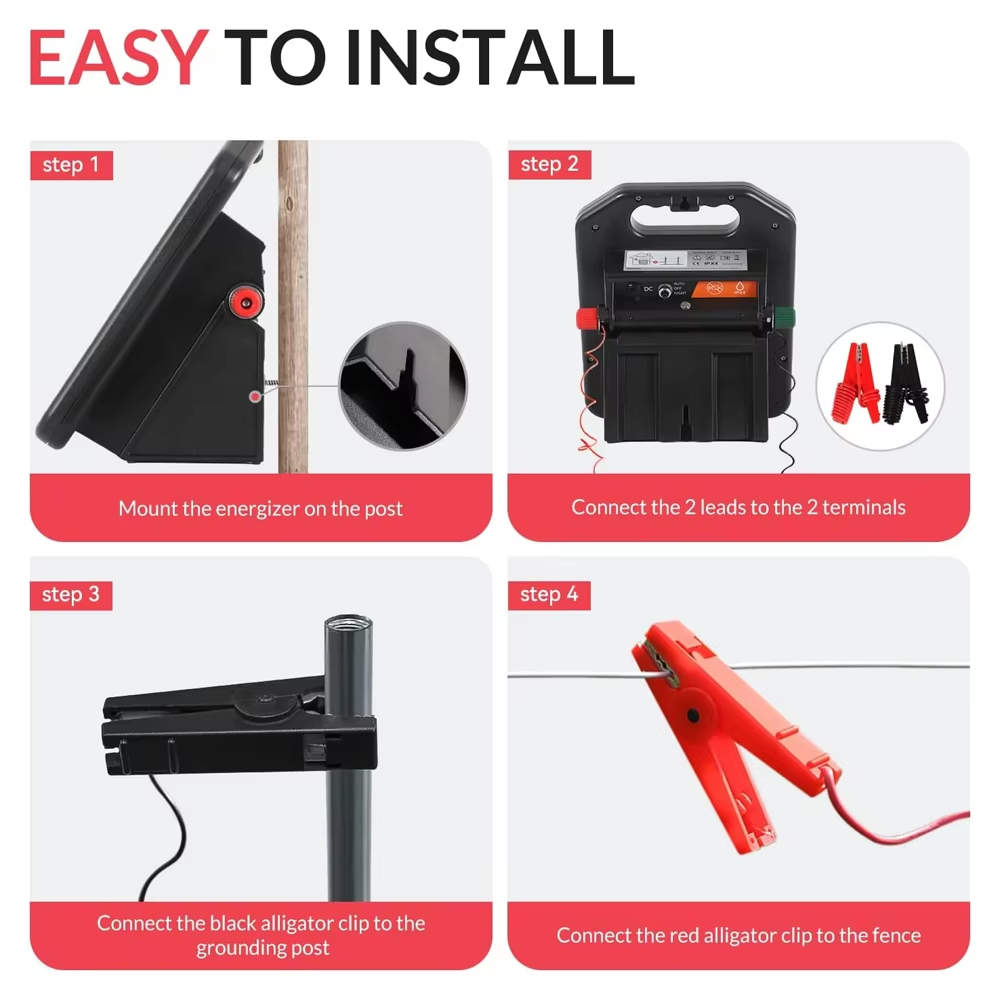
Correct installation is essential for reliable electric fence operation.
Step 1: Select a Suitable Installation Location
Install the energizer in a location with good solar exposure, away from unnecessary shading. Follow the manufacturer’s mounting and weather-protection instructions.
Step 2: Install the Grounding System
Connect the earth terminal to a grounding system designed for the energizer and soil conditions. Poor grounding can significantly reduce fence effectiveness.
Step 3: Connect the Fence Line
With the energizer switched off, connect the fence output terminal to the appropriate conductive fence line using compatible high-voltage cable and connectors.
Step 4: Activate and Test the System
Turn on the energizer according to its operating instructions. Use a suitable electric fence tester to check voltage at different points along the fence.
Always follow the energizer manufacturer’s instructions and applicable electrical fencing safety standards. Do not connect an energizer directly to mains power unless it is specifically designed and approved for that purpose.
Routine maintenance helps keep the fencing system operating consistently.
Clean the Solar Panel
Dust, mud, leaves, and other debris can reduce the amount of sunlight reaching the panel.
Inspect and clean the surface when necessary, following the manufacturer’s cleaning recommendations.
Check Battery Condition
Battery performance may gradually decline over time.
Inspect charging indicators and battery condition according to the manufacturer’s instructions. Use only compatible replacement batteries.
Inspect Fence Connections
Loose, corroded, or damaged electrical connections can increase resistance and reduce fence performance.
Regularly inspect connectors, conductor joints, and fence terminals.
Control Vegetation
Grass, weeds, and branches touching energized conductors can cause electrical leakage.
Keeping vegetation clear of the fence is especially important for low-output solar energizers.
Test Fence Voltage Regularly
Measure voltage at several locations along the fence rather than relying only on the energizer’s indicator light.
If voltage drops unexpectedly, inspect the fence for short circuits, damaged insulation, poor connections, or grounding problems.
|
Problem |
Possible cause |
Recommended action |
|---|---|---|
|
Energizer does not start |
Low battery, damaged connection |
Check battery and power connections |
|
Low fence voltage |
Vegetation, short circuit, poor grounding |
Inspect fence and grounding system |
|
Battery drains quickly |
Insufficient charging, aging battery |
Check solar exposure and battery condition |
|
Voltage drops over distance |
High conductor resistance, poor joints |
Inspect and improve conductor connections |
|
Inconsistent operation |
Weather, charging issues, system faults |
Test battery, panel and energizer |
Before performing repairs or changing connections, switch off the energizer. Repairs to internal electronics should be performed by qualified personnel.
A reliable electric fencing system requires properly matched components.
In addition to the solar energizer, buyers should consider the fence conductors, posts, insulators, connectors, gate handles, reels, grounding equipment, and voltage testers.
For example, a portable cattle grazing system may include a solar energizer, polywire, step-in posts, suitable insulators, a fence reel, and connection accessories.
A temporary sheep enclosure may instead use electric fence netting with compatible connection clips and grounding equipment.
Selecting compatible components can make installation easier, simplify maintenance, and improve overall fence performance.
At Shandong Hengtong New Materials Co., Ltd., we specialize in manufacturing a wide range of electric fencing products, including polywire, polytape, polyrope, electric fence netting, posts, reels, insulators, gate handles, and related accessories.
We understand that different markets require different product specifications.
For distributors, wholesalers, and agricultural equipment brands, we offer OEM and private-label customization, including:
Custom conductor materials and configurations
Different wire, rope, and tape specifications
Custom colors and roll lengths
Custom packaging and private-label branding
Matching electric fence accessories
Whether you are expanding an existing electric fencing product range or developing your own brand, we can help you source suitable fencing products and accessories for your target market.
Looking for an electric fencing manufacturing partner?
Visit www.hengtongfence.com to explore our product range or contact our team for a product catalogue and OEM consultation.